Bawean Deer
Axis kuhliiNo solid country presence documented yet.
Bawean Deer (Axis kuhlii): biology, habitats and field signs across its documented range, hunting-context reading.
Overview
Bawean Deer (Axis kuhlii) is presented here in a hunting-context reading across its documented range: biology, habitats and field signs useful to observers — without publishing season, quota or authorisation.
Classification: order Artiodactyla, family Cervidae, genus Axis. Common names: Bawean Deer in English, Cerf-cochon de Bawean in French, Ciervo de Kuhl in Spanish.
Identification
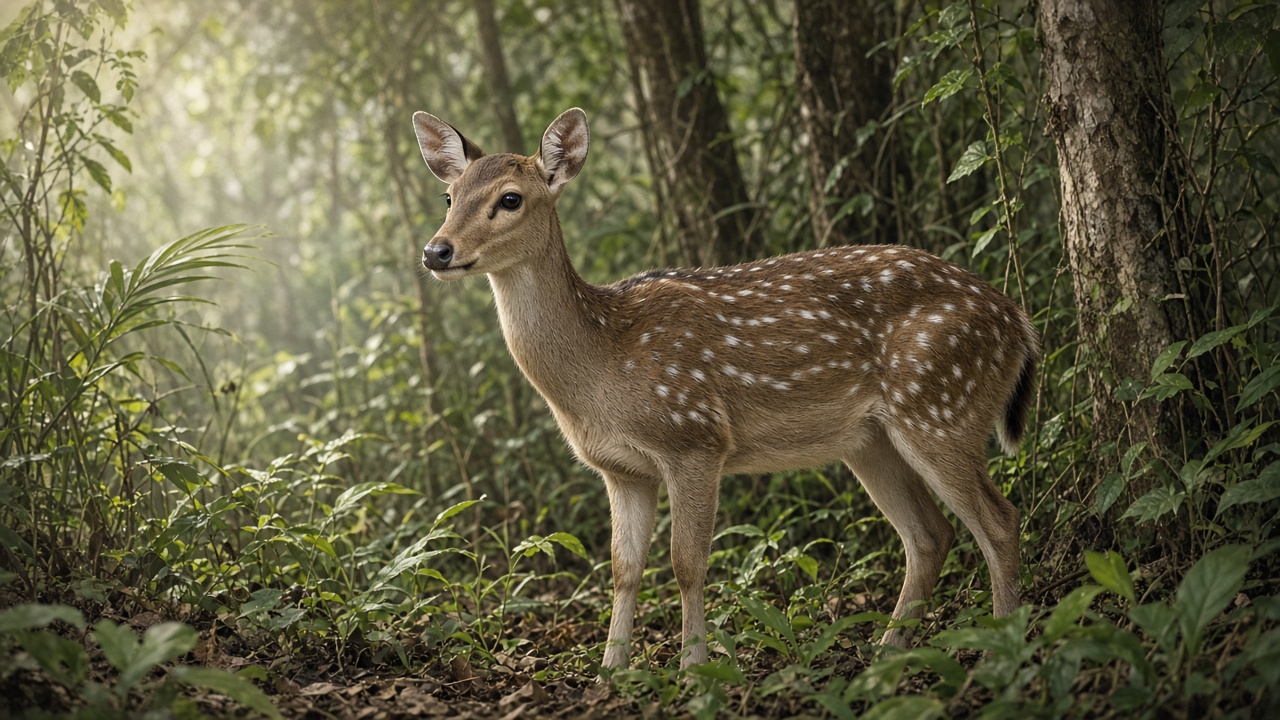
Close to the hog deer in size and shape but with noticeably shorter legs, the Bawean deer measures about 140 cm long and 65 to 70 cm at the shoulder, weighing 50 to 60 kg according to the measurements considered most reliable. The short, soft coat is light brown, each hair banded with yellow, giving a grizzled look at close range. The only markings are a pale throat bib, a pale eye-ring and a dark band separating the light lips from the face. The body is lower at the shoulder than at the hip. Only males carry slender three-tined antlers.
It grazes mainly on herbs and grasses, especially young lalang (Imperata cylindrica), and browses young leaves and twigs; at night it enters fields to eat young maize and cassava leaves. The rut is in September and October, though males with hard antlers are seen all year. After 225 to 230 days of gestation a single fawn is born, very rarely twins, mostly from February to June. The reticulated python is its only known natural predator; feral dogs caused most of the deaths examined in the late 1970s.
Habitats and range
Endemic to Bawean Island in the Java Sea, north of Java (Indonesia), it lives in the central mountain range and around Mount Bulu in the south-west, and on the Tanjung Cina peninsula in the north-west. It occurs in primary and secondary forest, reaching higher densities in the latter (up to 19.2 deer per km²), in hill forest rather than marshy grassland, up to 500 m above sea level. Its restriction to Bawean is a relict of a former presence on Java.
The countries where the species’ presence is established are shown in the tags on this sheet.
Field signs
Mostly nocturnal, it leaves dense cover after dark along well-trodden trails towards grassy clearings, the centre of its social life. Very wary, it is rarely seen, occasionally on the beach in the south-west of the island. It barks in strings of five to ten sharp barks audible at 100 m; challenging males also stamp on the ground. With no alarm call, it slips away quietly. Each deer leaves about 13 pellet groups a day.
Conservation
For conservation status of Axis kuhlii, consult the current IUCN assessment and cross with national monitoring programmes in countries of documented presence. Never turn a global IUCN category into a local hunting rule. GBIF occurrences help situate distribution but remain effort-biased.
The IUCN lists it as Critically Endangered: fewer than 250 mature individuals, at least 90% in a single subpopulation, out of a wild population estimated at 250 to 300 animals. Invasion by Chromolaena odorata (Eupatorium) and maturing teak plantations are reducing its grazing areas. It lives in the Bawean Island Nature Reserve (5,000 ha, established in 1979); in 2006, 300 to 350 animals were held in captivity off the island.
Limits
This sheet on the Bawean Deer publishes no season, quota, hunting method or fee: those rules differ between countries and territories and must be checked in official texts. Being described here does not mean a species may be hunted.
Local densities and management plans are not covered here: they are a matter for the managers of each area.
Sources
Sources consulted for this sheet:
- IUCN Red List — species search (consulted 2026-11-02)
- ASM Mammal Diversity Database — Axis kuhlii (consulted 2026-11-02)
- GBIF — species search (consulted 2026-11-02)
- ESABII Data Portal (Biodiversity Center of Japan, Ministry of the Environment) — Axis kuhlii (consulted 2026-11-04)
- Ultimate Ungulate — Bawean deer (Axis kuhlii), detailed fact sheet (consulted 2026-11-04)
Conclusion
In short: use the scientific name Axis kuhlii to cross-check sources, confirm taxonomy and conservation status on the institutional portals listed above, and relate every field sign to the habitat where it was actually found.
Identification
Axis kuhlii
Bawean Deer · preferred
Classification
Class : Mammalia
Order : Artiodactyla
Family : Cervidae
Genus : Axis
Conservation
IUCN : CR
CITES : —
iucn · CR (global)
Frequently asked questions
How do I recognise Bawean Deer?
Use Axis kuhlii as the scientific anchor. Close to the hog deer in size and shape but with noticeably shorter legs, the Bawean deer measures about 140 cm long and 65 to 70 cm at the shoulder, weighing 50 to 60 kg according to the measurements considered most reliable. The short, soft coat is light brown, each hair banded...
Where does Bawean Deer typically live?
Endemic to Bawean Island in the Java Sea, north of Java (Indonesia), it lives in the central mountain range and around Mount Bulu in the south-west, and on the Tanjung Cina peninsula in the north-west. It occurs in primary and secondary forest, reaching higher densities in the latter (up to 19.2 deer per km²), in hill forest rather than marshy grassland, up...
What field signs help confirm Bawean Deer?
Mostly nocturnal, it leaves dense cover after dark along well-trodden trails towards grassy clearings, the centre of its social life. Very wary, it is rarely seen, occasionally on the beach in the south-west of the island. It barks in strings of five to ten sharp barks audible at 100 m; challenging males also stamp on the ground. With no alarm call, it slips...