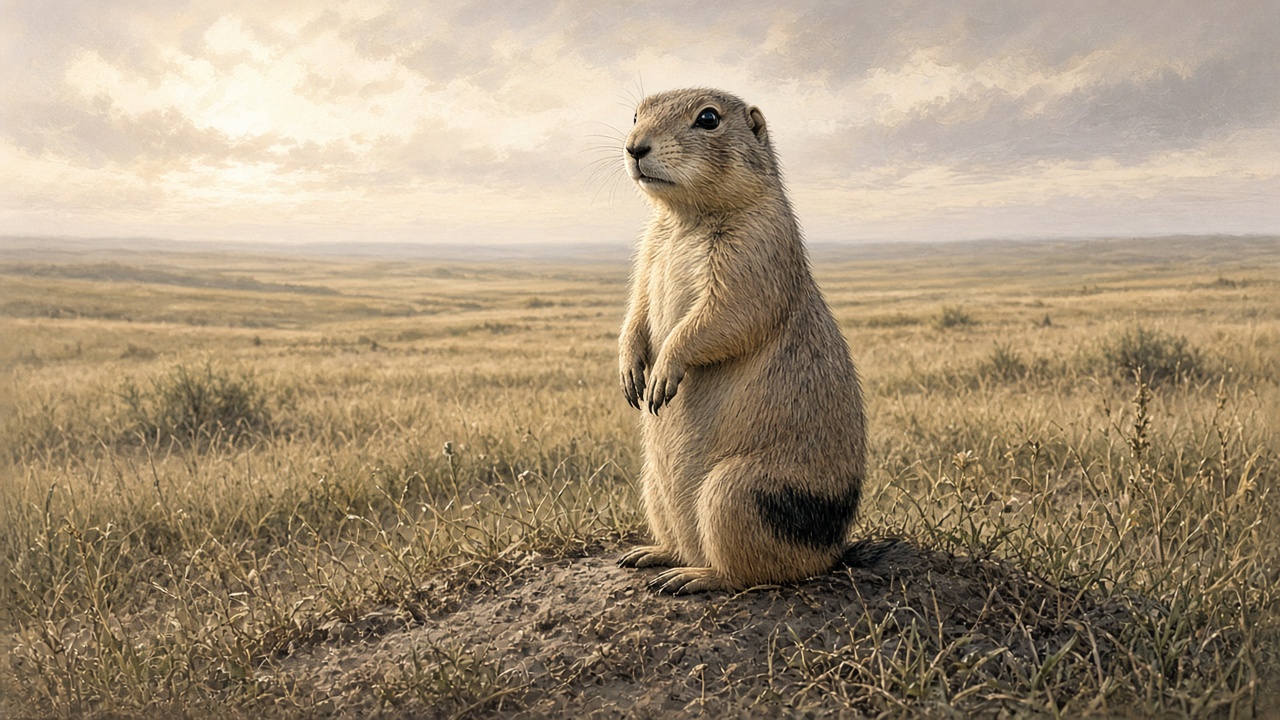
Black-tailed Prairie Dog
Cynomys ludovicianusBlack-tailed Prairie Dog (Cynomys ludovicianus): ecology sheet across its documented range — natural history and habitats, without hunting framing.
Seen in: United States
Overview
Black-tailed Prairie Dog (Cynomys ludovicianus) is an ecology sheet across its documented range: natural history and habitats, without any hunting framing.
Classification: order Rodentia, family Sciuridae, genus Cynomys. Common names: Black-tailed Prairie Dog in English, Chien de prairie à queue noire in French, Perrito de las praderas de cola negra in Spanish.
Identification
This stocky rodent measures 35 to 41.5 cm. Sexual dimorphism is clear: males (35.8 to 41.5 cm, 850 to 1,675 g) are larger than females (35.2 to 37.5 cm, 705 to 1,050 g), and both are heaviest in autumn and lightest in winter. The back is brownish to brownish-red, the belly whitish, and the coat is moulted twice a year. It is told from the Mexican prairie dog by non-overlapping ranges, and from the subgenus Leucocrossuromys (Gunnison’s, white-tailed and Utah prairie dogs), which hibernate, have white- to grey-tipped tails and give different alarm calls.
Diurnal, it stays active all year and does not hibernate. Over 98% of its diet is plant matter: leaves, stems and roots of grasses and forbs, with prickly pear, thistles and roots in winter; it occasionally eats grasshoppers or beetles and does not need to drink. Colonies are divided into “coteries” of related females with one or two territorial males. It breeds once a year, from January (Oklahoma) to late March–April (northern range); females are receptive for a single day. After 33 to 38 days, 1 to 8 young are born. Coyotes, American badgers, black-footed ferrets, bobcats, rattlesnakes, golden eagles and prairie falcons prey on it.
Habitats and range
MDD gives its range from Saskatchewan through Montana to eastern Nebraska, western Texas, New Mexico and south-eastern Arizona, reaching north-eastern Sonora and northern Chihuahua (Mexico). It uses open, level, arid short-grass plains, often near river flats or in coulee bottoms with sagebrush, greasewood and prickly pear, between 1,300 and 2,000 m, and never moist areas. Eradication by ranchers has reduced it to isolated populations, mostly on protected land.
The countries where the species’ presence is established are shown in the tags on this sheet.
Field signs
A colony is visible from afar: closely cropped vegetation, trimmed by the animals, and entrance mounds shaped like small volcanoes (1 to 1.5 m across, up to 1 m high) or flat domes 2 to 3 m wide; entrances are 10 to 30 cm across and a single coterie may have 70 of them. The species has twelve distinct calls, including the “jump-yip”, in which an animal stretches upright and throws its front paws into the air as it calls, setting off its neighbours.
Conservation
For conservation status of Cynomys ludovicianus, consult the current IUCN assessment and cross with national monitoring programmes in countries of documented presence. Never turn a global IUCN category into a local hunting rule. GBIF occurrences help situate distribution but remain effort-biased.
The IUCN lists it as Least Concern, but ADW recalls that it was long eradicated as a pest. A keystone species of the prairies, it underpins the survival of the highly endangered black-footed ferret, which depends on its colonies for food and shelter. Its fleas transmit the plague bacterium, which threatens colonies and can reach humans. It was described as Arctomys ludoviciana (Ord, 1815).
Limits
This sheet on the Black-tailed Prairie Dog covers biology and ecology only; it publishes no hunting season, quota or authorisation.
Local densities and management plans are not covered here: they are a matter for the managers of each area.
Sources
Sources consulted for this sheet:
- IUCN Red List — species search (consulted 2026-11-02)
- ASM Mammal Diversity Database — Cynomys ludovicianus (consulted 2026-11-02)
- GBIF — species search (consulted 2026-11-02)
- Animal Diversity Web — Cynomys ludovicianus (black-tailed prairie dog) (consulted 2026-11-04)
Conclusion
In short: use the scientific name Cynomys ludovicianus to cross-check sources, confirm taxonomy and conservation status on the institutional portals listed above, and relate every field sign to the habitat where it was actually found.
Identification
Cynomys ludovicianus
Black-tailed Prairie Dog · preferred
Chien de prairie à queue noire · preferred
Perrito de las praderas de cola negra · preferred
Arizona Black-tailed Prairie Dog
Classification
Class : Mammalia
Order : Rodentia
Family : Sciuridae
Genus : Cynomys
Conservation
IUCN : LC
CITES : —
iucn · LC (global)
Habitat
Frequently asked questions
How do I recognise Black-tailed Prairie Dog?
Use Cynomys ludovicianus as the scientific anchor. This stocky rodent measures 35 to 41.5 cm. Sexual dimorphism is clear: males (35.8 to 41.5 cm, 850 to 1,675 g) are larger than females (35.2 to 37.5 cm, 705 to 1,050 g), and both are heaviest in autumn and lightest in winter. The back is brownish to brownish-red, the belly whitis...
Where does Black-tailed Prairie Dog typically live?
MDD gives its range from Saskatchewan through Montana to eastern Nebraska, western Texas, New Mexico and south-eastern Arizona, reaching north-eastern Sonora and northern Chihuahua (Mexico). It uses open, level, arid short-grass plains, often near river flats or in coulee bottoms with sagebrush, greasewood and prickly pear, between 1,300 and 2,000 m, and nev...
What field signs help confirm Black-tailed Prairie Dog?
A colony is visible from afar: closely cropped vegetation, trimmed by the animals, and entrance mounds shaped like small volcanoes (1 to 1.5 m across, up to 1 m high) or flat domes 2 to 3 m wide; entrances are 10 to 30 cm across and a single coterie may have 70 of them. The species has twelve distinct calls, including the “jump-yip”, in which an animal stret...