Cape Hare
Lepus capensisCape Hare (Lepus capensis): biology, habitats and field signs across its documented range, hunting-context reading.
Seen in: Namibia · South Africa
Overview
Cape Hare (Lepus capensis) is presented here in a hunting-context reading across its documented range: biology, habitats and field signs useful to observers — without publishing season, quota or authorisation.
Classification: order Lagomorpha, family Leporidae, genus Lepus. Common names: Cape Hare in English, Lièvre du Cap in French, Liebre del Cabo in Spanish.
Identification
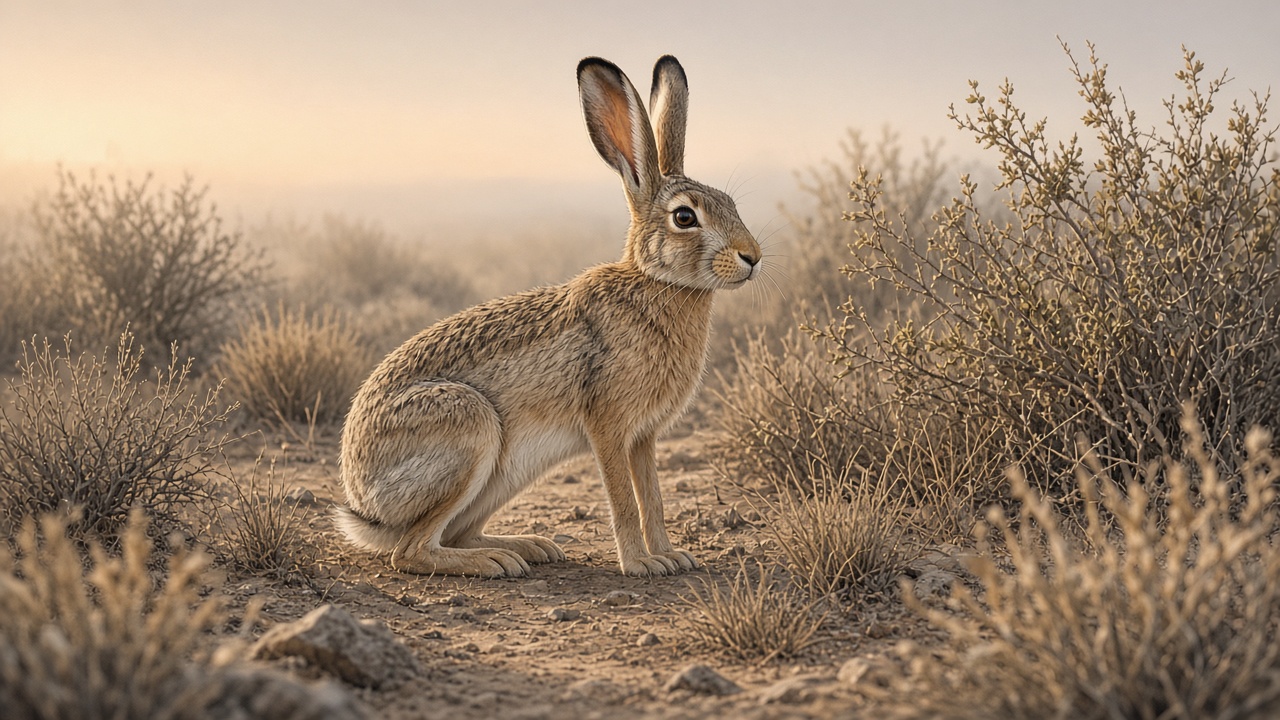
ADW describes the species in its broad sense as a slender hare with a bushy tail, 52 to 59.5 cm long and 4 to 5 kg. The oval head has very long, black-tipped ears (12 to 14 cm) and large reddish-brown eyes giving a 360-degree field of view. The hind legs are very long and powerful. The upperparts are ginger-brown shaded with black, the breast and sides more ginger, the belly and inner legs white and the nape reddish-grey. According to MDD, these measurements and this description cover a set of populations now being split apart.
A herbivore, it eats herbaceous plants, cereals, berries, vegetables and some fungi, and re-ingests part of the droppings produced at night to obtain proteins and vitamins. Rather than hiding, it relies on running: up to about 77 km/h, with leaps of nearly 2.5 m. Before breeding, males chase each other and “box” standing on their hind legs. After about forty days of gestation, 1 to 6 well-developed leverets are born, weaned and independent at about one month. Raptors and foxes, including the Cape fox, are its predators.
Habitats and range
In the broad sense, MDD describes two separate, non-forested ranges: southern Africa (South Africa, Namibia, Botswana, Zimbabwe, southern Angola, Mozambique) and, to the north, East Africa, the Sahel, the Sahara and North Africa, through Sinai to the Arabian Peninsula, Jordan, southern Syria and western Iraq. ADW lists open land (meadows, pastures, cultivated fields, sandy moors, marshes) close to hedges and thickets, and even arid deserts; the IUCN cites shrubland, grassland, desert and farmland, up to 1,800 m.
The countries where the species’ presence is established are shown in the tags on this sheet.
Field signs
Diurnal according to ADW, it is seen lying at rest, or pressed flat and motionless as soon as it detects a sound or danger, before bolting at speed across open ground. Early in the breeding season, males chasing each other and then boxing upright are characteristic. Where it is abundant, it can damage young forest plantations and crops.
Conservation
For conservation status of Lepus capensis, consult the current IUCN assessment and cross with national monitoring programmes in countries of documented presence. Never turn a global IUCN category into a local hunting rule. GBIF occurrences help situate distribution but remain effort-biased.
The IUCN lists it as Least Concern (2018 assessment), with a decreasing population; the threats cited are urban development, agriculture, roads, recreational activities and invasive species or diseases. MDD notes that the species formerly included L. mediterraneus, L. schlumbergeri and L. saharae (North and West Africa, Sardinia) and that true Lepus capensis probably occurs only in southern Africa.
Limits
This sheet on the Cape Hare publishes no season, quota, hunting method or fee: those rules differ between countries and territories and must be checked in official texts. Being described here does not mean a species may be hunted.
Local densities and management plans are not covered here: they are a matter for the managers of each area.
Sources
Sources consulted for this sheet:
- IUCN Red List — species search (consulted 2026-11-02)
- ASM Mammal Diversity Database — Lepus capensis (consulted 2026-11-02)
- GBIF — species search (consulted 2026-11-02)
- Animal Diversity Web — Lepus capensis (Cape hare) (consulted 2026-11-04)
Conclusion
In short: use the scientific name Lepus capensis to cross-check sources, confirm taxonomy and conservation status on the institutional portals listed above, and relate every field sign to the habitat where it was actually found.
Identification
Lepus capensis
Cape Hare · preferred
Lièvre du Cap · preferred
Liebre del Cabo · preferred
Arabian Hare
East African Hare
South African Hare
Classification
Class : Mammalia
Order : Lagomorpha
Family : Leporidae
Genus : Lepus
Conservation
IUCN : LC
CITES : —
iucn · LC (global)
Habitat
Frequently asked questions
How do I recognise Cape Hare?
Use Lepus capensis as the scientific anchor. ADW describes the species in its broad sense as a slender hare with a bushy tail, 52 to 59.5 cm long and 4 to 5 kg. The oval head has very long, black-tipped ears (12 to 14 cm) and large reddish-brown eyes giving a 360-degree field of view. The hind legs are very long and powerfu...
Where does Cape Hare typically live?
In the broad sense, MDD describes two separate, non-forested ranges: southern Africa (South Africa, Namibia, Botswana, Zimbabwe, southern Angola, Mozambique) and, to the north, East Africa, the Sahel, the Sahara and North Africa, through Sinai to the Arabian Peninsula, Jordan, southern Syria and western Iraq. ADW lists open land (meadows, pastures, cultivate...
What field signs help confirm Cape Hare?
Diurnal according to ADW, it is seen lying at rest, or pressed flat and motionless as soon as it detects a sound or danger, before bolting at speed across open ground. Early in the breeding season, males chasing each other and then boxing upright are characteristic. Where it is abundant, it can damage young forest plantations and crops.