Caracal
Caracal caracalCaracal (Caracal caracal): coexistence sheet across its documented range — presence, biology and prudence, without an invented hunting status.
Seen in: Namibia · South Africa
Overview
Caracal (Caracal caracal) is a coexistence sheet across its documented range: presence, biology and prudence — not a hunting status claim.
Classification: order Carnivora, family Felidae, genus Caracal. Common names: Caracal in English, Caracal in French, Caracal in Spanish.
Identification
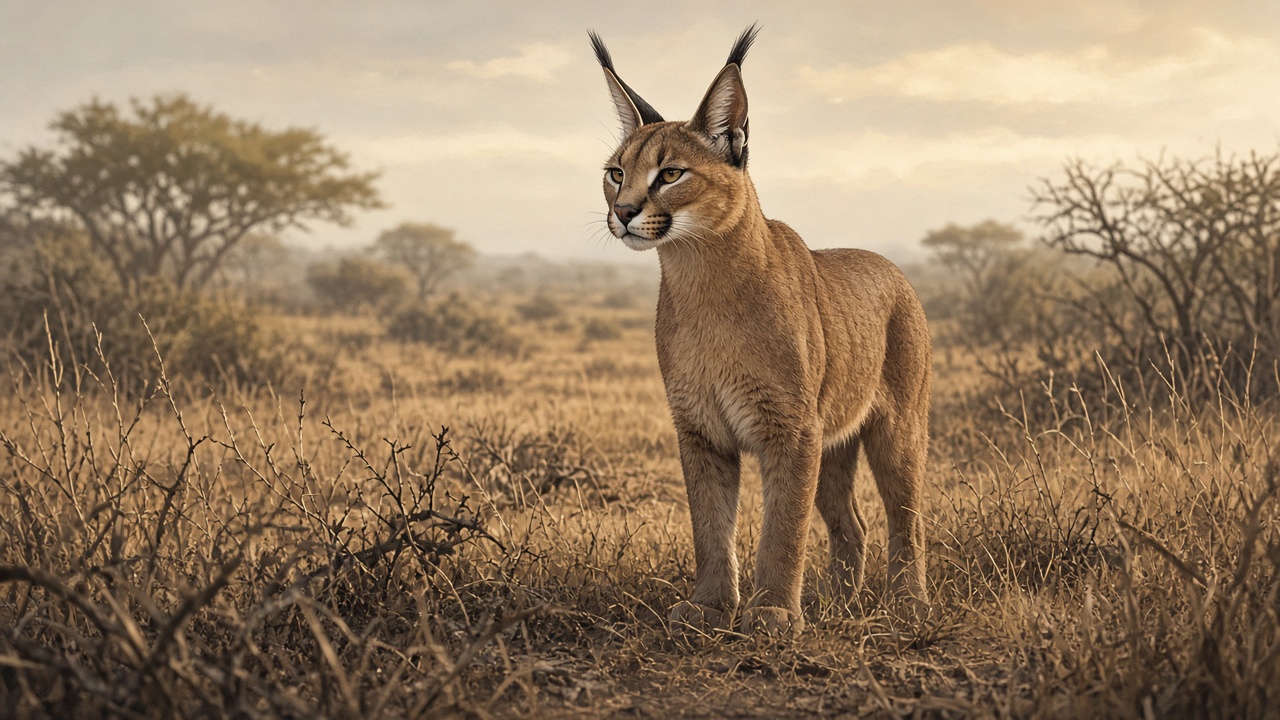
The caracal is a slender cat, larger than most domestic cats: 62 to 91 cm in head and body with a short tail of 18 to 34 cm; males reach 20 kg, females 13 kg at most. The coat is brown to reddish, white below with many small spots; the face has black marks on the whisker pads and around the eyes. Its long, black-tufted ears are its most distinctive feature; the hind legs are tall, well muscled and clearly longer than the forelegs.
A strict carnivore, it takes hyraxes, hares, rodents, antelopes, small monkeys and birds, which it snatches with spectacular leaps; it can kill prey two to three times its own weight. Solitary and territorial, mainly nocturnal, it is a skilled climber. Females can come into oestrus at any time of year; after 68 to 81 days of gestation, they give birth to 1 to 6 kittens, rarely more than 3 in the wild, in a tree cavity, cave or abandoned burrow.
Habitats and range
Its range covers much of Africa, bounded by the Sahara and the equatorial forest belt, plus the Near East, the Arabian Peninsula and Central and south-western Asia as far as India (MDD). North African populations are shrinking; Asian ones are less dense. It uses woodland, thickets, scrub forest, plains and rocky hills, especially forest–grassland edges, and prefers an arid climate with little plant cover; it occurs above 3,000 m in the mountains of Ethiopia.
The countries where the species’ presence is established are shown in the tags on this sheet.
Field signs
Mostly nocturnal, it can be seen by day in undisturbed areas. Threatened in open country, it lies flat, its plain coat acting as camouflage. It rarely hoists prey into trees: it scrapes earth over an unfinished carcass and keeps coming back to eat until it is gone. During the breeding period, females leave urine scent marks in various places.
Conservation
For conservation status of Caracal caracal, consult the current IUCN assessment and cross with national monitoring programmes in countries of documented presence. Never turn a global IUCN category into a local hunting rule. GBIF occurrences help situate distribution but remain effort-biased.
The IUCN lists it as Least Concern. The main threat is habitat loss in northern, central and western Africa and in Asia. In South Africa and Namibia, thousands of caracals are killed every year for preying on small livestock, but the species quickly recolonises farmland. CITES lists Asian populations in Appendix I and all others in Appendix II.
Limits
This sheet on the Caracal covers presence and biology. A species being present in a country does not mean it may be hunted, and no season or quota is published here.
Local densities and management plans are not covered here: they are a matter for the managers of each area.
Sources
Sources consulted for this sheet:
- IUCN Red List — species search (consulted 2026-11-02)
- ASM Mammal Diversity Database — Caracal caracal (consulted 2026-11-02)
- GBIF — species search (consulted 2026-11-02)
- Animal Diversity Web — Caracal caracal (caracal) (consulted 2026-11-04)
Conclusion
In short: use the scientific name Caracal caracal to cross-check sources, confirm taxonomy and conservation status on the institutional portals listed above, and relate every field sign to the habitat where it was actually found.
Identification
Caracal caracal
Caracal · preferred
Caracal · preferred
Caracal · preferred
Red Lynx
Caracal Lynx
Classification
Class : Mammalia
Order : Carnivora
Family : Felidae
Genus : Caracal
Conservation
IUCN : LC
CITES : —
iucn · LC (global)
Habitat
Frequently asked questions
How do I recognise Caracal?
Use Caracal caracal as the scientific anchor. The caracal is a slender cat, larger than most domestic cats: 62 to 91 cm in head and body with a short tail of 18 to 34 cm; males reach 20 kg, females 13 kg at most. The coat is brown to reddish, white below with many small spots; the face has black marks on the whisker pads and...
Where does Caracal typically live?
Its range covers much of Africa, bounded by the Sahara and the equatorial forest belt, plus the Near East, the Arabian Peninsula and Central and south-western Asia as far as India (MDD). North African populations are shrinking; Asian ones are less dense. It uses woodland, thickets, scrub forest, plains and rocky hills, especially forest–grassland edges, and...
What field signs help confirm Caracal?
Mostly nocturnal, it can be seen by day in undisturbed areas. Threatened in open country, it lies flat, its plain coat acting as camouflage. It rarely hoists prey into trees: it scrapes earth over an unfinished carcass and keeps coming back to eat until it is gone. During the breeding period, females leave urine scent marks in various places.