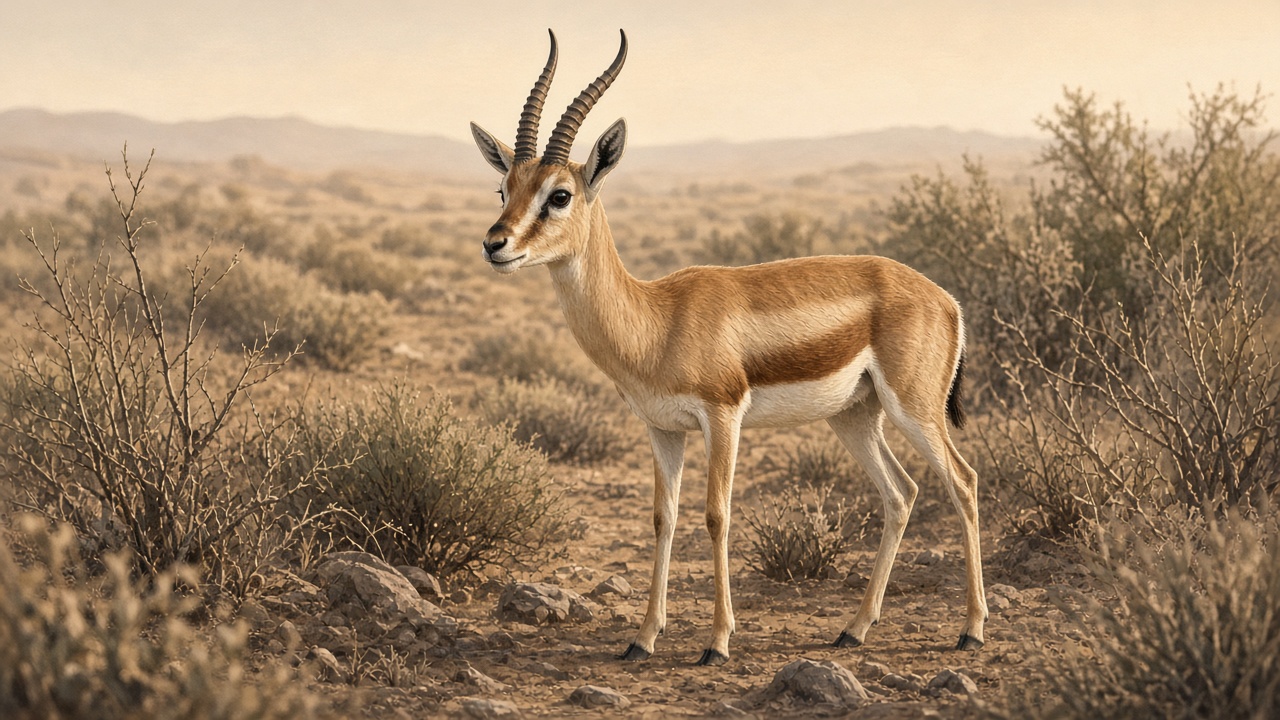
Dorcas Gazelle
Gazella dorcasNo solid country presence documented yet.
Dorcas Gazelle (Gazella dorcas): coexistence sheet across its documented range — presence, biology and prudence, without an invented hunting status.
Overview
Dorcas Gazelle (Gazella dorcas) is a coexistence sheet across its documented range: presence, biology and prudence — not a hunting status claim.
Classification: order Artiodactyla, family Bovidae, genus Gazella. Common names: Dorcas Gazelle in English, Gazelle dorcas in French, Gacela dorcas in Spanish.
Identification
The second-smallest gazelle, the dorcas gazelle averages 16.5 kg for males and 12.6 kg for females, with variation between populations. Generally pale, it has a white belly edged on each side by a brown stripe; the shade varies, from ochre with darker flank stripes in the northern Sahara to reddish-brown with faint pale stripes near the Red Sea. The head is darker than the body. Its horns are the most curved in the genus: 25 to 28 cm with 20 to 24 rings in males, and 17 to 19 cm, straighter, with 16 to 18 rings in females.
It eats the flowers, leaves and pods of acacias and on the fruit and leaves of shrubs; in the Negev it digs into the sand in summer to reach the stem and bulb of the lily Pancratium sickenbergeri, and it can live without ever drinking. In hot weather it is active at dawn and dusk, all day in milder conditions, and turns nocturnal under pressure from daytime predators. It lives in pairs or in groups of one or two males with up to four females and their young. The rut runs from September to November; after six months a single fawn is born with open eyes. Cheetahs, lions, leopards, servals, caracals, wolves and hyenas prey on it.
Habitats and range
According to MDD it occurs in Algeria, Chad, Djibouti, Egypt, Eritrea, northern Ethiopia, southern Israel, western Jordan, Libya, Mali, Mauritania, Morocco, Niger, northern Somalia, northern Sudan and Tunisia; it is only a vagrant in northern Nigeria and seasonal, reintroduced, in Senegal. It is the gazelle best equipped for dry country: savannah, semi-desert, dune fields, consolidated dunes and wadis. A male and his group use about 25 km².
The countries where the species’ presence is established are shown in the tags on this sheet.
Field signs
During the rut, males mark their territory with dung piles. In the Negev, holes dug in the sand to reach lily bulbs betray its presence. When uneasy it gives an alarm call like a short bark; faced with a predator it shivers its skin, twitches its tail and bounds away in high, springy leaps with the head held up (“stotting”), warning the whole group.
Conservation
For conservation status of Gazella dorcas, consult the current IUCN assessment and cross with national monitoring programmes in countries of documented presence. Never turn a global IUCN category into a local hunting rule. GBIF occurrences help situate distribution but remain effort-biased.
The IUCN lists it as Vulnerable. ADW cites habitat destruction and illegal killing as the main threats; many of its natural predators have also been wiped out across its range. MDD includes the forms saudiya and pelzelnii, recognised as species by Groves and Grubb (2011), hence the other names Pelzeln’s gazelle and Saudi gazelle linked to this taxon.
Limits
This sheet on the Dorcas Gazelle covers presence and biology. A species being present in a country does not mean it may be hunted, and no season or quota is published here.
Local densities and management plans are not covered here: they are a matter for the managers of each area.
Sources
Sources consulted for this sheet:
- IUCN Red List — species search (consulted 2026-11-02)
- ASM Mammal Diversity Database — Gazella dorcas (consulted 2026-11-02)
- GBIF — species search (consulted 2026-11-02)
- Animal Diversity Web — Gazella dorcas (dorcas gazelle) (consulted 2026-11-04)
Conclusion
In short: use the scientific name Gazella dorcas to cross-check sources, confirm taxonomy and conservation status on the institutional portals listed above, and relate every field sign to the habitat where it was actually found.
Identification
Gazella dorcas
Dorcas Gazelle · preferred
Gazelle dorcas · preferred
Gacela dorcas · preferred
Pelzeln's Gazelle
Saudi Gazelle
Classification
Class : Mammalia
Order : Artiodactyla
Family : Bovidae
Genus : Gazella
Conservation
IUCN : VU
CITES : —
iucn · VU (global)
Habitat
Frequently asked questions
How do I recognise Dorcas Gazelle?
Use Gazella dorcas as the scientific anchor. The second-smallest gazelle, the dorcas gazelle averages 16.5 kg for males and 12.6 kg for females, with variation between populations. Generally pale, it has a white belly edged on each side by a brown stripe; the shade varies, from ochre with darker flank stripes in the norther...
Where does Dorcas Gazelle typically live?
According to MDD it occurs in Algeria, Chad, Djibouti, Egypt, Eritrea, northern Ethiopia, southern Israel, western Jordan, Libya, Mali, Mauritania, Morocco, Niger, northern Somalia, northern Sudan and Tunisia; it is only a vagrant in northern Nigeria and seasonal, reintroduced, in Senegal. It is the gazelle best equipped for dry country: savannah, semi-deser...
What field signs help confirm Dorcas Gazelle?
During the rut, males mark their territory with dung piles. In the Negev, holes dug in the sand to reach lily bulbs betray its presence. When uneasy it gives an alarm call like a short bark; faced with a predator it shivers its skin, twitches its tail and bounds away in high, springy leaps with the head held up (“stotting”), warning the whole group.