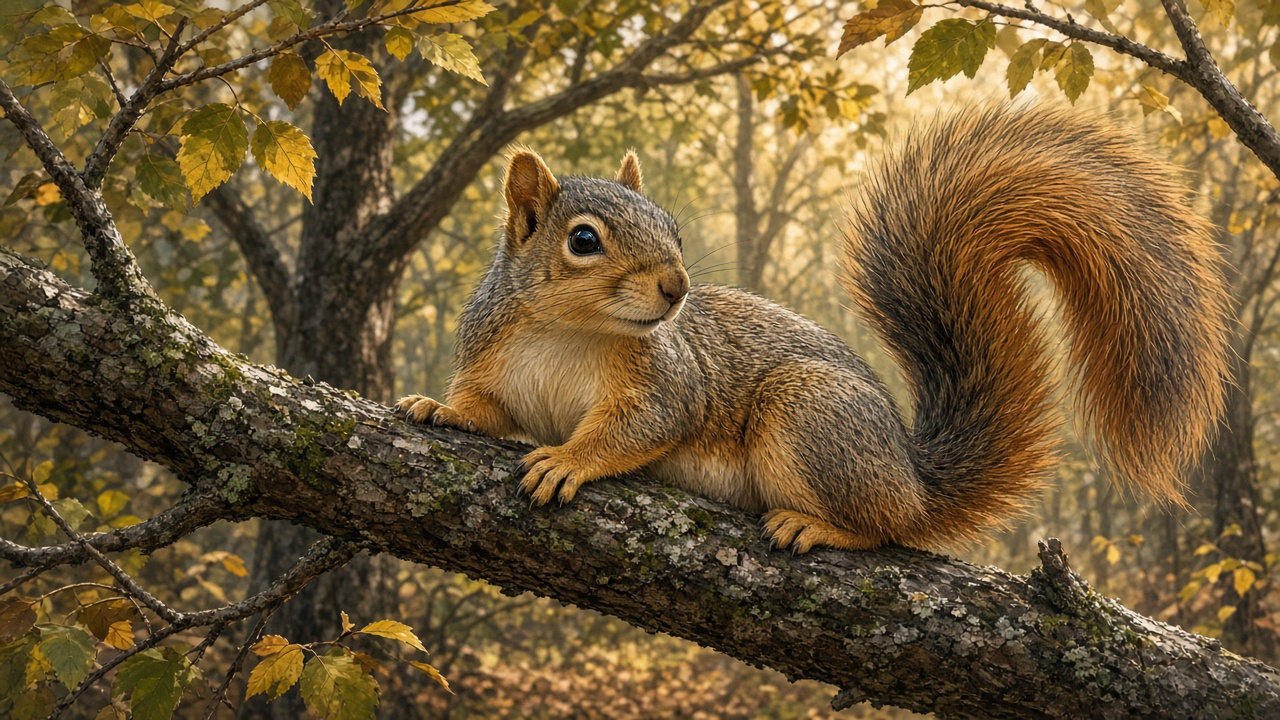
Eastern Fox Squirrel (Sciurus niger): ecology sheet across its documented range — natural history and habitats, without hunting framing.
Seen in: United States
Overview
Eastern Fox Squirrel (Sciurus niger) is an ecology sheet across its documented range: natural history and habitats, without any hunting framing.
Classification: order Rodentia, family Sciuridae, genus Sciurus. Common names: Eastern Fox Squirrel in English, Écureuil fauve in French, Ardilla zorro in Spanish.
Identification
The eastern fox squirrel is a medium-sized tree squirrel: 45 to 70 cm in total length (59.5 cm on average) and 700 g to 1.2 kg, averaging 800 g. The back ranges from buff to orange and the belly is rufous; some forms in the south-eastern United States are entirely black. The tail is well furred and ear tufts often grow in winter. Males and females look alike. Sharp, recurved claws and strong forelimb and abdominal muscles make it a fast, agile climber.
Diurnal and mainly arboreal, it lives alone except when a female comes into oestrus: several males then follow her and a dominance hierarchy decides who mates. Mating peaks in December–February and May–June; after 44 to 45 days of gestation, an average of 2 to 3 naked young are born, opening their eyes at about five weeks and weaned at about eight. It favours acorns, hickory nuts, walnuts, mulberries and hawthorn seeds, but also eats insects, eggs, nestlings and dead fish. Large hawks and owls are its main predators; snakes take young.
Habitats and range
According to MDD, it ranges from Texas and adjacent north-eastern Mexico north to Manitoba in Canada and east to the Atlantic coast of the United States. It has been introduced into cities in western North America. It lives in deciduous and mixed forests, preferably with a good variety of tree species, since nut crops vary from one tree species to another; it also occurs in urban, suburban and riverside settings.
The countries where the species’ presence is established are shown in the tags on this sheet.
Field signs
It is seen by day in trees or on the ground searching for seeds, which it buries in scattered caches for winter. To threaten a rival it stands upright with its tail over its back, then gives it a quick flick. Barks, chatters and alarm calls give away a predator. It readily raids bird tables, gardens and cornfields, and travels along power lines.
Conservation
For conservation status of Sciurus niger, consult the current IUCN assessment and cross with national monitoring programmes in countries of documented presence. Never turn a global IUCN category into a local hunting rule. GBIF occurrences help situate distribution but remain effort-biased.
The IUCN lists it as Least Concern, but several subspecies have been endangered by overhunting and the loss of mature forests. MDD places it in the subgenus Parasciurus and notes a proposal to raise that group to a full genus, not followed for now. MDD also lists regional names such as Delmarva fox squirrel and Big Cypress fox squirrel.
Limits
This sheet on the Eastern Fox Squirrel covers biology and ecology only; it publishes no hunting season, quota or authorisation.
Local densities and management plans are not covered here: they are a matter for the managers of each area.
Sources
Sources consulted for this sheet:
- IUCN Red List — species search (consulted 2026-11-02)
- ASM Mammal Diversity Database — Sciurus niger (consulted 2026-11-02)
- GBIF — species search (consulted 2026-11-02)
- Animal Diversity Web — Sciurus niger (eastern fox squirrel) (consulted 2026-11-04)
Conclusion
In short: use the scientific name Sciurus niger to cross-check sources, confirm taxonomy and conservation status on the institutional portals listed above, and relate every field sign to the habitat where it was actually found.
Identification
Sciurus niger
Écureuil fauve · preferred
Ardilla zorro · preferred
Eastern Fox Squirrel · preferred
Bryant's Fox Squirrel
Cat Squirrel
Delmarva Fox Squirrel
Fox Squirrel
Stump-eared Squirrel
Western Fox Squirrel
Big Cypress Fox Squirrel
Classification
Class : Mammalia
Order : Rodentia
Family : Sciuridae
Genus : Sciurus
Conservation
IUCN : LC
CITES : —
iucn · LC (global)
Habitat
Frequently asked questions
How do I recognise Eastern Fox Squirrel?
Use Sciurus niger as the scientific anchor. The eastern fox squirrel is a medium-sized tree squirrel: 45 to 70 cm in total length (59.5 cm on average) and 700 g to 1.2 kg, averaging 800 g. The back ranges from buff to orange and the belly is rufous; some forms in the south-eastern United States are entirely black. The tail...
Where does Eastern Fox Squirrel typically live?
According to MDD, it ranges from Texas and adjacent north-eastern Mexico north to Manitoba in Canada and east to the Atlantic coast of the United States. It has been introduced into cities in western North America. It lives in deciduous and mixed forests, preferably with a good variety of tree species, since nut crops vary from one tree species to another; i...
What field signs help confirm Eastern Fox Squirrel?
It is seen by day in trees or on the ground searching for seeds, which it buries in scattered caches for winter. To threaten a rival it stands upright with its tail over its back, then gives it a quick flick. Barks, chatters and alarm calls give away a predator. It readily raids bird tables, gardens and cornfields, and travels along power lines.