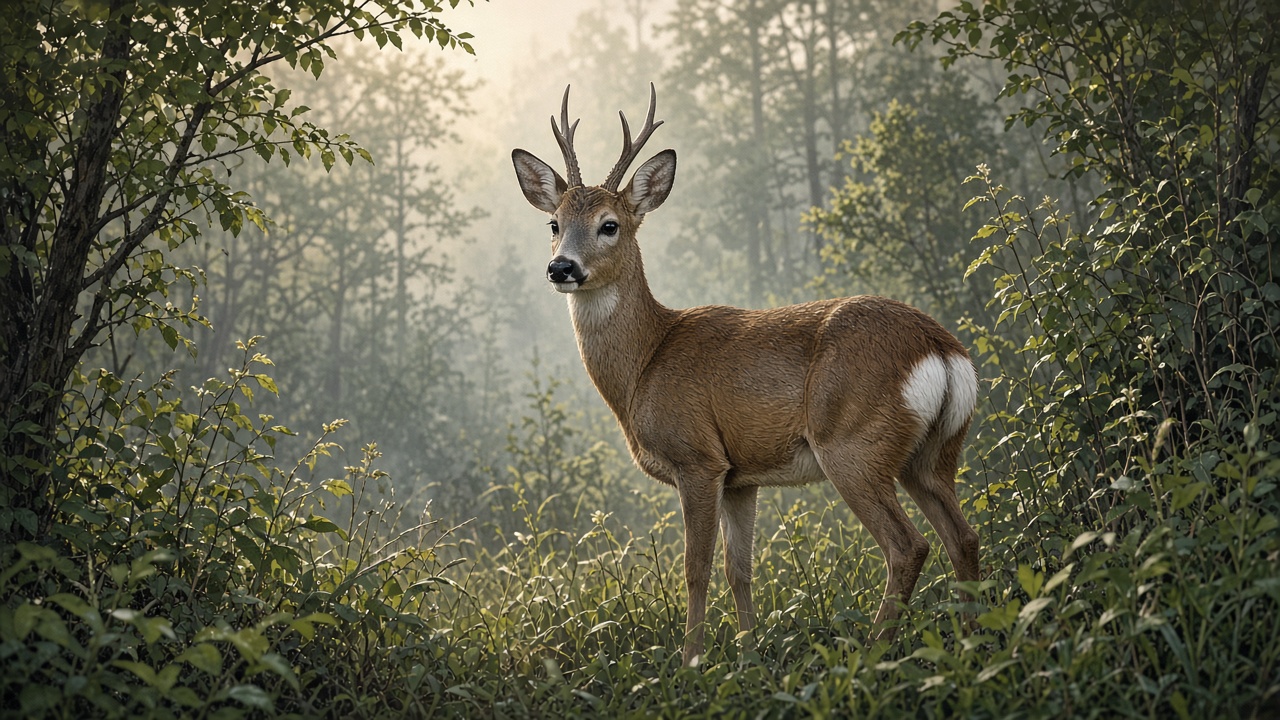
Eastern Roe Deer
Capreolus pygargusNo solid country presence documented yet.
Eastern Roe Deer (Capreolus pygargus): biology, habitats and field signs across its documented range, hunting-context reading.
Overview
Eastern Roe Deer (Capreolus pygargus) is presented here in a hunting-context reading across its documented range: biology, habitats and field signs useful to observers — without publishing season, quota or authorisation.
Classification: order Artiodactyla, family Cervidae, genus Capreolus. Common names: Eastern Roe Deer in English, Chevreuil de Sibérie in French, Corzo siberiano in Spanish.
Identification
Larger than the western roe deer, the eastern or Siberian roe deer is 126.7 to 144.4 cm long and 82 to 94 cm at the shoulder, with a 2 to 4 cm tail, and usually weighs 32 to 49 kg (up to 65 kg). The hind legs are longer than the forelegs. The coat is taupe in winter and bright reddish-orange in summer, with a cream belly; fawns are spotted. Males, slightly heavier, carry knobbly antlers 28 to 33 cm long that slant backwards and upwards, usually with three tines. It differs from the western roe deer in size, in more widely spaced antler pedicles and in its reddish rather than grey-brown summer coat.
Crepuscular, it alternates on average seven foraging bouts a day with rest periods. It eats leaves, flowers and stems of herbs and woody plants, and in winter twigs, mosses, lichens and fungi; more than 600 plant species are recorded in its diet. The rut runs from mid-July to mid-September, but the embryo only implants in January after about four months of diapause. Fawns are born from May to early July, usually twins of 1.8 to 2.2 kg. Leopards, lynx and wolves are its natural predators, and more rarely Amur tigers, snow leopards and brown bears.
Habitats and range
Its range runs from the southern Urals, northern and eastern Kazakhstan and Kyrgyzstan across southern Siberia to the Pacific, south into northern and central China (Xinjiang and Inner Mongolia to Sichuan), northern Mongolia and Korea, with isolated populations on Jeju Island and on the northern slopes of the Caucasus. It lives in temperate forest, near regenerating burns and clearings, up to 3,300 m; the highest densities occur in grassland, tall-grass meadows and floodplains. It tolerates −60 °C and snow 50 cm deep.
The countries where the species’ presence is established are shown in the tags on this sheet.
Field signs
During the rut, mainly in August and September, males mark territories by scraping trees with their antlers and depositing secretions from head glands and a mix of urine and tarsal gland oils. Males bark as a territorial display; fawns squeak to call their mothers. In September and October it migrates 100 to 300 km, up to 500 km, sometimes in groups of 500 animals, returning in March or April.
Conservation
For conservation status of Capreolus pygargus, consult the current IUCN assessment and cross with national monitoring programmes in countries of documented presence. Never turn a global IUCN category into a local hunting rule. GBIF occurrences help situate distribution but remain effort-biased.
The IUCN lists it as Least Concern, but ADW describes a decline driven by overhunting and poaching, made worse by climate change, and by the conversion of land to livestock grazing in Russia; in China and both Koreas, poaching and habitat loss are also reducing numbers. The isolated Caucasus population is at risk of inbreeding. Long treated as a subspecies of the western roe deer, it was separated after studies in 1987 and 1991.
Limits
This sheet on the Eastern Roe Deer publishes no season, quota, hunting method or fee: those rules differ between countries and territories and must be checked in official texts. Being described here does not mean a species may be hunted.
Local densities and management plans are not covered here: they are a matter for the managers of each area.
Sources
Sources consulted for this sheet:
- IUCN Red List — species search (consulted 2026-11-02)
- ASM Mammal Diversity Database — Capreolus pygargus (consulted 2026-11-02)
- GBIF — species search (consulted 2026-11-02)
- Animal Diversity Web — Capreolus pygargus (eastern roe deer) (consulted 2026-11-04)
Conclusion
In short: use the scientific name Capreolus pygargus to cross-check sources, confirm taxonomy and conservation status on the institutional portals listed above, and relate every field sign to the habitat where it was actually found.
Identification
Capreolus pygargus
Chevreuil de Sibérie · preferred
Corzo siberiano · preferred
Eastern Roe Deer · preferred
Siberian Roe Deer
Classification
Class : Mammalia
Order : Artiodactyla
Family : Cervidae
Genus : Capreolus
Conservation
IUCN : LC
CITES : —
iucn · LC (global)
Habitat
Frequently asked questions
How do I recognise Eastern Roe Deer?
Use Capreolus pygargus as the scientific anchor. Larger than the western roe deer, the eastern or Siberian roe deer is 126.7 to 144.4 cm long and 82 to 94 cm at the shoulder, with a 2 to 4 cm tail, and usually weighs 32 to 49 kg (up to 65 kg). The hind legs are longer than the forelegs. The coat is taupe in winter and bright re...
Where does Eastern Roe Deer typically live?
Its range runs from the southern Urals, northern and eastern Kazakhstan and Kyrgyzstan across southern Siberia to the Pacific, south into northern and central China (Xinjiang and Inner Mongolia to Sichuan), northern Mongolia and Korea, with isolated populations on Jeju Island and on the northern slopes of the Caucasus. It lives in temperate forest, near rege...
What field signs help confirm Eastern Roe Deer?
During the rut, mainly in August and September, males mark territories by scraping trees with their antlers and depositing secretions from head glands and a mix of urine and tarsal gland oils. Males bark as a territorial display; fawns squeak to call their mothers. In September and October it migrates 100 to 300 km, up to 500 km, sometimes in groups of 500 a...