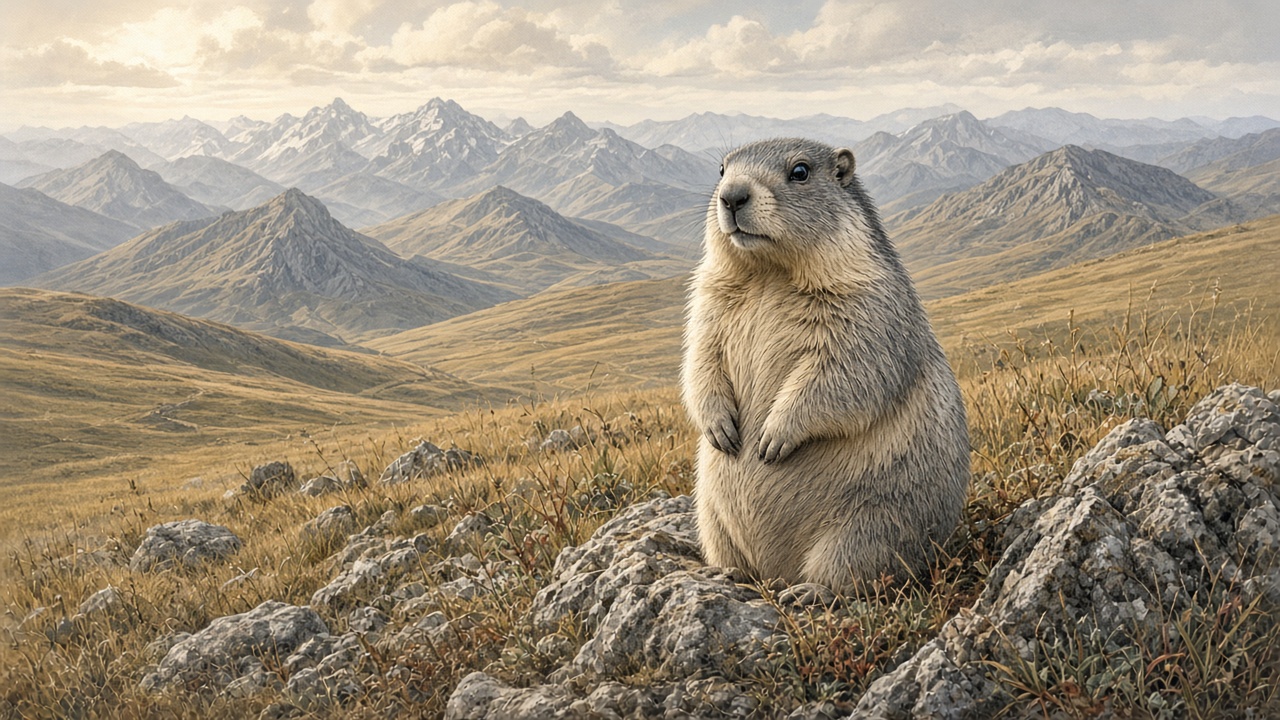
Gray Marmot
Marmota baibacinaNo solid country presence documented yet.
Gray Marmot (Marmota baibacina): ecology sheet across its documented range — natural history and habitats, without hunting framing.
Overview
Gray Marmot (Marmota baibacina) is an ecology sheet across its documented range: natural history and habitats, without any hunting framing.
Classification: order Rodentia, family Sciuridae, genus Marmota. Common names: Gray Marmot in English, Marmotte grise in French, Marmota gris in Spanish.
Identification
The gray marmot is one of the largest marmots in Asia: 59 to 80 cm in total length and about 4 to 6.5 kg. Its short tail (13 to 15 cm) ends in a dark brown to black tip. The back looks grey because the sandy fur has almost black tips; the face is light greyish-brown. The body is low-slung on short, thick legs, with small furred ears.
Diurnal and social, it lives in colonies of 6 to 20 animals. It hibernates for seven to eight months, from late August or early October until spring, in winter burrows deeper than summer ones that can hold about ten animals. Mating takes place from early May to early June; after about 40 days of gestation, 2 to 6 young are born. It feeds mainly on grasses and herbs.
Habitats and range
Its range covers the Altai and Tian Shan: south-western Siberia, south-eastern Kazakhstan, Kyrgyzstan, western Mongolia and Xinjiang (China). It has been introduced to the Caucasus (Dagestan). It lives in mountain grasslands and meadows, steppe and up into alpine tundra; where it overlaps with the Mongolian marmot (tarbagan), it tends to hold the ridges.
The countries where the species’ presence is established are shown in the tags on this sheet.
Field signs
Colonies show up as burrows with spoil heaps and animals sitting at the entrance in sunny weather. When alarmed, marmots give an alarm call and flag the raised tail up and down. Outside the active season, from September–October to spring, colonies look deserted.
Conservation
For conservation status of Marmota baibacina, consult the current IUCN assessment and cross with national monitoring programmes in countries of documented presence. Never turn a global IUCN category into a local hunting rule. GBIF occurrences help situate distribution but remain effort-biased.
The IUCN lists it as Least Concern. Living alongside the Mongolian marmot, a known plague carrier, it may also host the fleas that transmit it; eating or handling an infected animal carries that risk. MDD notes that the species formerly included Marmota kastschenkoi, now treated as separate.
Limits
This sheet on the Gray Marmot covers biology and ecology only; it publishes no hunting season, quota or authorisation.
Local densities and management plans are not covered here: they are a matter for the managers of each area.
Sources
Sources consulted for this sheet:
- IUCN Red List — species search (consulted 2026-11-02)
- ASM Mammal Diversity Database — Marmota baibacina (consulted 2026-11-02)
- GBIF — species search (consulted 2026-11-02)
- Animal Diversity Web — Marmota baibacina (gray marmot) (consulted 2026-11-04)
Conclusion
In short: use the scientific name Marmota baibacina to cross-check sources, confirm taxonomy and conservation status on the institutional portals listed above, and relate every field sign to the habitat where it was actually found.
Identification
Marmota baibacina
Gray Marmot · preferred
Classification
Class : Mammalia
Order : Rodentia
Family : Sciuridae
Genus : Marmota
Conservation
IUCN : LC
CITES : —
iucn · LC (global)
Habitat
Frequently asked questions
How do I recognise Gray Marmot?
Use Marmota baibacina as the scientific anchor. The gray marmot is one of the largest marmots in Asia: 59 to 80 cm in total length and about 4 to 6.5 kg. Its short tail (13 to 15 cm) ends in a dark brown to black tip. The back looks grey because the sandy fur has almost black tips; the face is light greyish-brown. The body is...
Where does Gray Marmot typically live?
Its range covers the Altai and Tian Shan: south-western Siberia, south-eastern Kazakhstan, Kyrgyzstan, western Mongolia and Xinjiang (China). It has been introduced to the Caucasus (Dagestan). It lives in mountain grasslands and meadows, steppe and up into alpine tundra; where it overlaps with the Mongolian marmot (tarbagan), it tends to hold the ridges.
What field signs help confirm Gray Marmot?
Colonies show up as burrows with spoil heaps and animals sitting at the entrance in sunny weather. When alarmed, marmots give an alarm call and flag the raised tail up and down. Outside the active season, from September–October to spring, colonies look deserted.