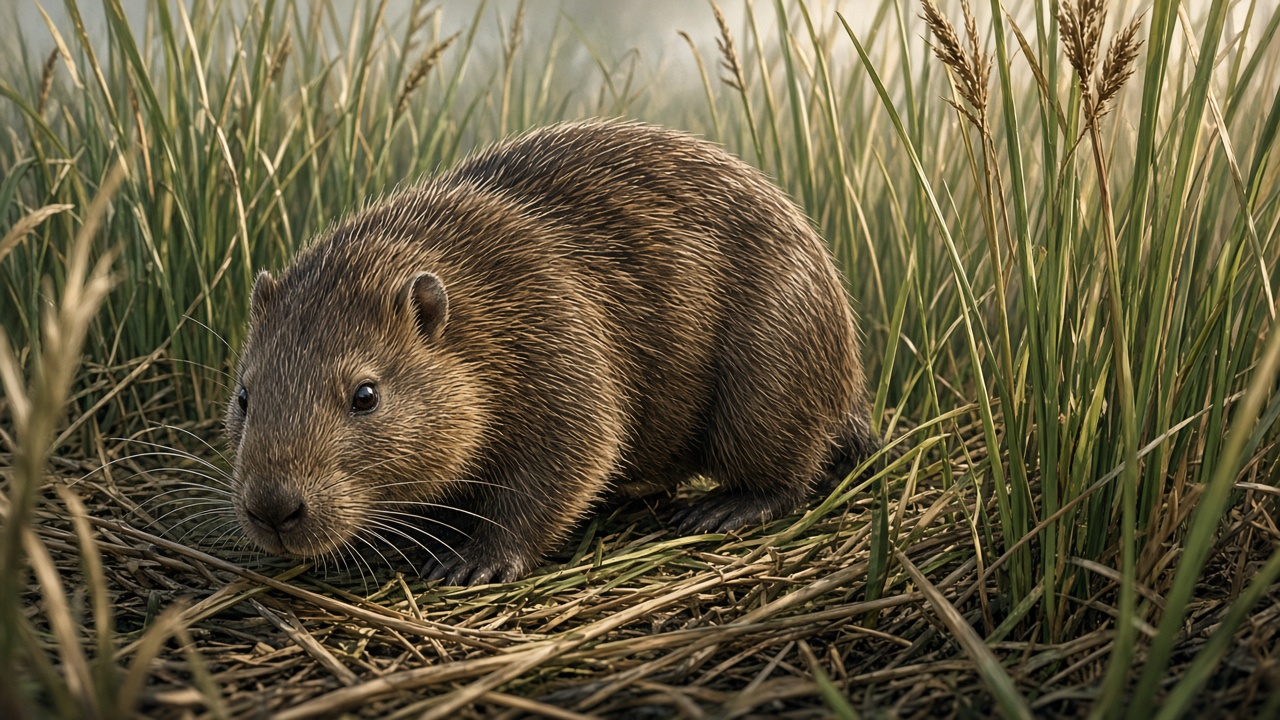
Greater Cane Rat
Thryonomys swinderianusGreater Cane Rat (Thryonomys swinderianus): coexistence sheet across its documented range — presence, biology and prudence, without an invented hunting status.
Seen in: Namibia · South Africa
Overview
Greater Cane Rat (Thryonomys swinderianus) is a coexistence sheet across its documented range: presence, biology and prudence — not a hunting status claim.
Classification: order Rodentia, family Thryonomyidae, genus Thryonomys. Common names: Greater Cane Rat in English, Aulacode in French, Rata de caña grande in Spanish.
Identification
A large, heavy-set rodent: 35 to 61 cm in head and body, with a 6.5 to 26 cm tail and 3 to 9 kg, averaging 4.5 kg in males and 3.5 kg in females. The nose is rounded, the ears short and the incisors grow continuously. The coarse coat has no underfur and is made of flattened, bristle-like hairs in groups of five or six: yellowish brown above, light grey below. The smaller forelimbs have three well-developed middle digits; the hind limbs lack the first digit, and all digits carry heavy claws.
A herbivore, it eats mainly grasses and cane, favouring elephant grass and moist plants rich in sugars, plus bark, fallen fruit and nuts; it also raids sugar cane, maize, millet, cassava, sweet potatoes and pumpkins. Nocturnal, it lives in groups of one male, several females and young; in the dry season males leave to live alone. After a 137- to 172-day gestation, females have two litters a year of about four young, born furred, with eyes open and able to run.
Habitats and range
It ranges across Africa south of the Sahara, from Gambia to South Sudan and south to northern Namibia and South Africa, except the south-west of that country. Naturally tied to marshes and riverbanks, it also reaches very high densities in crop plantations, and its habitat is spreading where forest is converted to farmland.
The countries where the species’ presence is established are shown in the tags on this sheet.
Field signs
It cuts runways through grass and reeds linking its shelter to eating places and water, flattens tall grass to make nests and digs shallow burrows. When it cuts grass with its incisors it makes a fairly loud and very distinctive chattering sound. When frightened it thumps its hind limbs and grunts, or dashes for water: it swims and dives well. Males fight by pushing nose to nose.
Conservation
For conservation status of Thryonomys swinderianus, consult the current IUCN assessment and cross with national monitoring programmes in countries of documented presence. Never turn a global IUCN category into a local hunting rule. GBIF occurrences help situate distribution but remain effort-biased.
The IUCN lists it as Least Concern (MDD, ADW). The species is not threatened, but some populations have disappeared locally, mainly through overexploitation for its meat, which is highly prized in Africa. It is also regarded as a serious crop pest. Temminck described it in 1827 as Aulacodus swinderianus; MDD lists the English names Cutting-grass, Grass Cutter and Marsh Cane Rat.
Limits
This sheet on the Greater Cane Rat covers presence and biology. A species being present in a country does not mean it may be hunted, and no season or quota is published here.
Local densities and management plans are not covered here: they are a matter for the managers of each area.
Sources
Sources consulted for this sheet:
- IUCN Red List — species search (consulted 2026-11-02)
- ASM Mammal Diversity Database — Thryonomys swinderianus (consulted 2026-11-02)
- GBIF — species search (consulted 2026-11-02)
- Animal Diversity Web — Thryonomys swinderianus (greater cane rat) (consulted 2026-11-04)
Conclusion
In short: use the scientific name Thryonomys swinderianus to cross-check sources, confirm taxonomy and conservation status on the institutional portals listed above, and relate every field sign to the habitat where it was actually found.
Identification
Thryonomys swinderianus
Greater Cane Rat · preferred
Aulacode · preferred
Rata de caña grande · preferred
Cutting-grass
Grass Cutter
Marsh Cane Rat
Classification
Class : Mammalia
Order : Rodentia
Family : Thryonomyidae
Genus : Thryonomys
Conservation
IUCN : LC
CITES : —
iucn · LC (global)
Habitat
Frequently asked questions
How do I recognise Greater Cane Rat?
Use Thryonomys swinderianus as the scientific anchor. A large, heavy-set rodent: 35 to 61 cm in head and body, with a 6.5 to 26 cm tail and 3 to 9 kg, averaging 4.5 kg in males and 3.5 kg in females. The nose is rounded, the ears short and the incisors grow continuously. The coarse coat has no underfur and is made of flattened, bris...
Where does Greater Cane Rat typically live?
It ranges across Africa south of the Sahara, from Gambia to South Sudan and south to northern Namibia and South Africa, except the south-west of that country. Naturally tied to marshes and riverbanks, it also reaches very high densities in crop plantations, and its habitat is spreading where forest is converted to farmland.
What field signs help confirm Greater Cane Rat?
It cuts runways through grass and reeds linking its shelter to eating places and water, flattens tall grass to make nests and digs shallow burrows. When it cuts grass with its incisors it makes a fairly loud and very distinctive chattering sound. When frightened it thumps its hind limbs and grunts, or dashes for water: it swims and dives well. Males fight by...