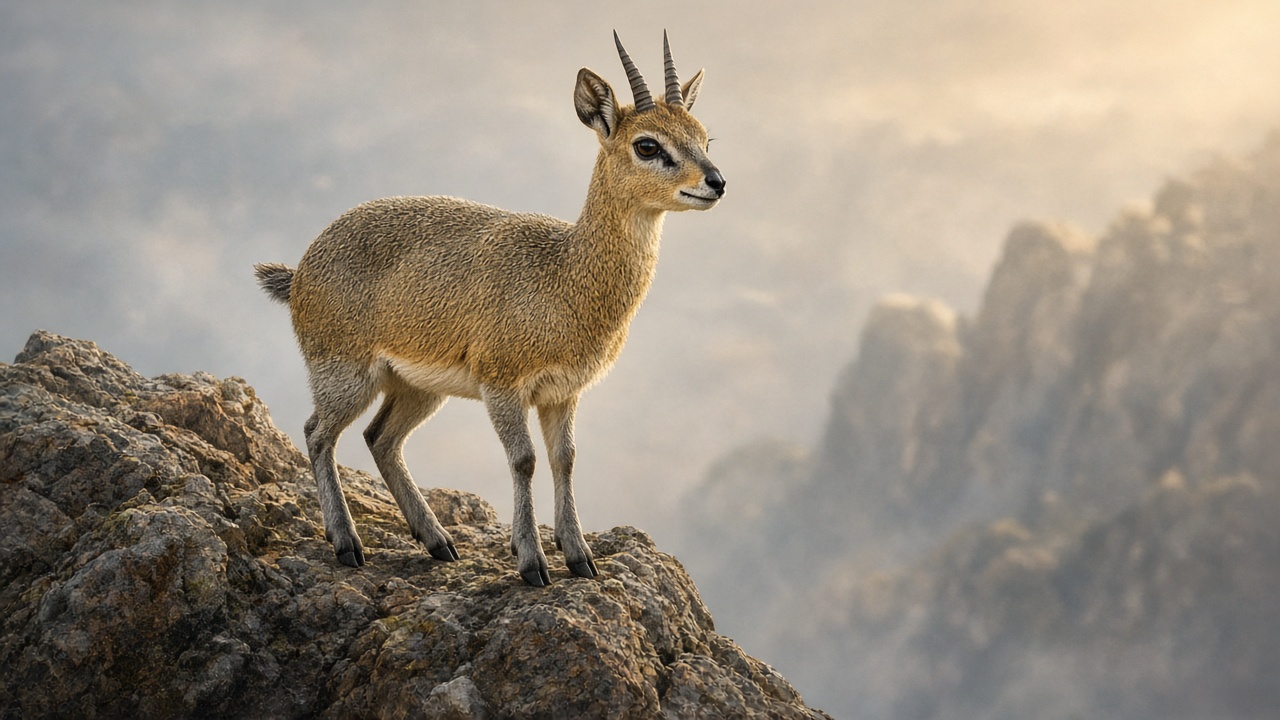
Klipspringer
Oreotragus oreotragusKlipspringer (Oreotragus oreotragus): coexistence sheet across its documented range — presence, biology and prudence, without an invented hunting status.
Seen in: Namibia · South Africa
Overview
Klipspringer (Oreotragus oreotragus) is a coexistence sheet across its documented range: presence, biology and prudence — not a hunting status claim.
Classification: order Artiodactyla, family Bovidae, genus Oreotragus. Common names: Klipspringer in English, Oréotrague in French, Saltarrocas in Spanish.
Identification
A small, stocky antelope of 8 to 18 kg, 75 to 115 cm long and 43 to 51 cm at the shoulder, the klipspringer has a short neck, powerful hindquarters and large rounded ears; females are slightly heavier than males. It walks on the tips of cylindrical hooves. The hollow, springy hair is yellow speckled with brown, golden or greyer depending on region; the belly, chin and lips are white. The short, straight horns average about 10 cm: only males carry them in southern Africa, both sexes in Kenya and Tanzania.
It lives alone, in monogamous pairs or in small family groups (2.6 animals on average), and is most active early in the morning and late in the afternoon. Fruit and flowers make up about two thirds of its diet; it ignores grasses and gets most of its water from food and dew. While the group forages, one member, usually the male, stands guard. A single young of about 1 kg is born after six months of gestation, every 16 months, and stays hidden for two to three months. Leopards and caracals are its main predators.
Habitats and range
Its range is patchy: from north-eastern Sudan, Eritrea, northern Somalia and the Ethiopian Highlands through East and southern Africa to the west coast of Namibia and south-western Angola; MDD also lists central Nigeria and the Central African Republic. It is strictly tied to rock: rocky hills and outcrops, koppies and gorges, up to 4,000 m. It sometimes crosses up to 10 km of flat ground between koppies. Territories cover 0.08 to 0.15 km² depending on rainfall.
The countries where the species’ presence is established are shown in the tags on this sheet.
Field signs
It leaves dung along territory boundaries and marks twigs and grass stems with 4 to 6 mm smears of black secretion from its preorbital glands, renewed about every seven days. When alarmed it freezes, then gives a nasal whistle audible 0.7 km away and runs 30 to 50 m to higher ground; the pair then whistles in duet, facing the danger.
Conservation
For conservation status of Oreotragus oreotragus, consult the current IUCN assessment and cross with national monitoring programmes in countries of documented presence. Never turn a global IUCN category into a local hunting rule. GBIF occurrences help situate distribution but remain effort-biased.
The IUCN lists it as Least Concern; ADW cites a population of about 40,000. It avoids populated areas such as the Cape Peninsula. MDD groups under this name ten forms (aceratos, aureus, schillingsi, stevensoni, transvaalensis, etc.) that Groves and Grubb (2011) split as species, and lists it as possibly extinct in Burundi. Its name comes from Afrikaans for “rock jumper”.
Limits
This sheet on the Klipspringer covers presence and biology. A species being present in a country does not mean it may be hunted, and no season or quota is published here.
Local densities and management plans are not covered here: they are a matter for the managers of each area.
Sources
Sources consulted for this sheet:
- IUCN Red List — species search (consulted 2026-11-02)
- ASM Mammal Diversity Database — Oreotragus oreotragus (consulted 2026-11-02)
- GBIF — species search (consulted 2026-11-02)
- Animal Diversity Web — Oreotragus oreotragus (klipspringer) (consulted 2026-11-04)
Conclusion
In short: use the scientific name Oreotragus oreotragus to cross-check sources, confirm taxonomy and conservation status on the institutional portals listed above, and relate every field sign to the habitat where it was actually found.
Identification
Oreotragus oreotragus
Oréotrague · preferred
Saltarrocas · preferred
Klipspringer · preferred
Classification
Class : Mammalia
Order : Artiodactyla
Family : Bovidae
Genus : Oreotragus
Conservation
IUCN : LC
CITES : —
iucn · LC (global)
Habitat
Frequently asked questions
How do I recognise Klipspringer?
Use Oreotragus oreotragus as the scientific anchor. A small, stocky antelope of 8 to 18 kg, 75 to 115 cm long and 43 to 51 cm at the shoulder, the klipspringer has a short neck, powerful hindquarters and large rounded ears; females are slightly heavier than males. It walks on the tips of cylindrical hooves. The hollow, springy hai...
Where does Klipspringer typically live?
Its range is patchy: from north-eastern Sudan, Eritrea, northern Somalia and the Ethiopian Highlands through East and southern Africa to the west coast of Namibia and south-western Angola; MDD also lists central Nigeria and the Central African Republic. It is strictly tied to rock: rocky hills and outcrops, koppies and gorges, up to 4,000 m. It sometimes cro...
What field signs help confirm Klipspringer?
It leaves dung along territory boundaries and marks twigs and grass stems with 4 to 6 mm smears of black secretion from its preorbital glands, renewed about every seven days. When alarmed it freezes, then gives a nasal whistle audible 0.7 km away and runs 30 to 50 m to higher ground; the pair then whistles in duet, facing the danger.