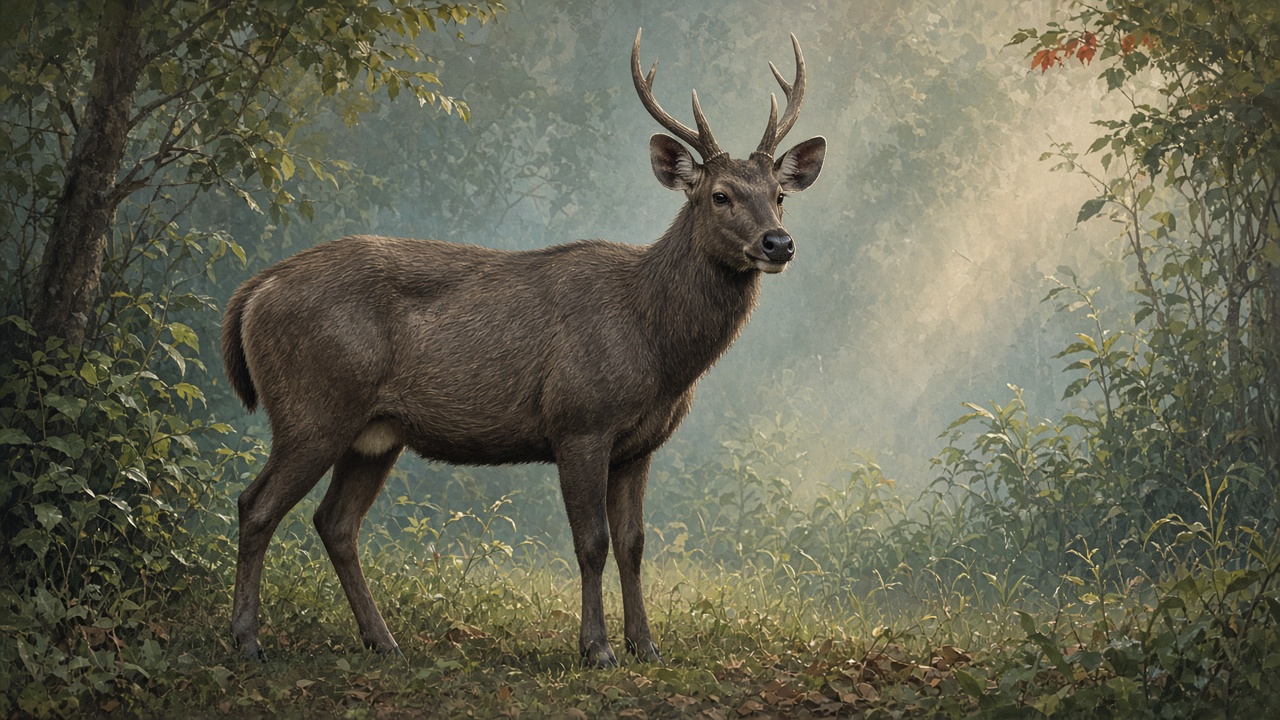
Sambar (Rusa unicolor): biology, habitats and field signs across its documented range, hunting-context reading.
Seen in: Australia
Overview
Sambar (Rusa unicolor) is presented here in a hunting-context reading across its documented range: biology, habitats and field signs useful to observers — without publishing season, quota or authorisation.
Classification: order Artiodactyla, family Cervidae, genus Rusa. Common names: Sambar in English, Sambar in French, Sambar in Spanish.
Identification
A large deer of 109 to 260 kg and 1.62 to 2.46 m in length, the sambar has a coarse coat of short, dark hair, light brown to creamy white on the underside. Its bushy tail is white at the back and underneath; when raised it acts as a signal. Males, larger than females (185 to 260 kg at most, against about 162 kg), have a dense neck mane and antlers with three or four tines, up to 100 cm long and shed and regrown periodically. Fawns are born brown with pale spots, which they soon lose.
It forages at dusk and at night on leaves, berries, grasses, bark from young trees, fallen fruit, herbs and buds, mainly in clearings and along forest edges. With no strict breeding season, it mates mostly from September to January; after 8 to 9 months of gestation a single fawn of about 10 kg is usually born, staying with its mother for one to two years. During the rut, solitary, aggressive males defend territories marked with scent glands, where up to eight females may stay. Tigers are among its predators.
Habitats and range
According to MDD, it ranges from India and Sri Lanka to southern China (eastern Tibet and Sichuan to Yunnan, Hainan Island) and Taiwan, and south to Peninsular Malaysia, Sumatra, Borneo, Siberut, Sipora, Pagai and Nias. ADW reports introductions to Australia, New Zealand, California, Florida and Texas. It lives on gently sloping and steep forested hillsides, preferably near crops and plantations, but also in thick forest, swamp forest and open scrub, from sea level to 3,700 m.
The countries where the species’ presence is established are shown in the tags on this sheet.
Field signs
Mostly nocturnal, it spends the day under heavy forest cover and comes out at dusk into clearings and forest edges. It is seen alone or in small groups of females (up to six) with their young. The raised white tail serves as a signal. A strong swimmer, it may be seen in water. Bark stripped from young trees and damaged crops near villages show where it has been.
Conservation
For conservation status of Rusa unicolor, consult the current IUCN assessment and cross with national monitoring programmes in countries of documented presence. Never turn a global IUCN category into a local hunting rule. GBIF occurrences help situate distribution but remain effort-biased.
The IUCN lists it as Vulnerable (MDD, ADW). ADW links its crepuscular and nocturnal habits to human hunting pressure and gives more than 50,000 animals in India and over 5,000 in Australia, with no global estimate. Formerly Cervus unicolor, it is placed in Rusa by MDD, which includes equinus, treated as a separate species by Groves and Grubb (2011). ADW mentions the subspecies equinus, unicolor, brookei and dejeani.
Limits
This sheet on the Sambar publishes no season, quota, hunting method or fee: those rules differ between countries and territories and must be checked in official texts. Being described here does not mean a species may be hunted.
Local densities and management plans are not covered here: they are a matter for the managers of each area.
Sources
Sources consulted for this sheet:
- IUCN Red List — species search (consulted 2026-11-02)
- ASM Mammal Diversity Database — Rusa unicolor (consulted 2026-11-02)
- GBIF — species search (consulted 2026-11-02)
- Animal Diversity Web — Rusa unicolor (sambar) (consulted 2026-11-04)
Conclusion
In short: use the scientific name Rusa unicolor to cross-check sources, confirm taxonomy and conservation status on the institutional portals listed above, and relate every field sign to the habitat where it was actually found.
Identification
Rusa unicolor
Sambar · preferred
Sambar · preferred
Sambar · preferred
Classification
Class : Mammalia
Order : Artiodactyla
Family : Cervidae
Genus : Rusa
Conservation
IUCN : VU
CITES : —
iucn · VU (global)
Frequently asked questions
How do I recognise Sambar?
Use Rusa unicolor as the scientific anchor. A large deer of 109 to 260 kg and 1.62 to 2.46 m in length, the sambar has a coarse coat of short, dark hair, light brown to creamy white on the underside. Its bushy tail is white at the back and underneath; when raised it acts as a signal. Males, larger than females (185 to 260...
Where does Sambar typically live?
According to MDD, it ranges from India and Sri Lanka to southern China (eastern Tibet and Sichuan to Yunnan, Hainan Island) and Taiwan, and south to Peninsular Malaysia, Sumatra, Borneo, Siberut, Sipora, Pagai and Nias. ADW reports introductions to Australia, New Zealand, California, Florida and Texas. It lives on gently sloping and steep forested hillsides,...
What field signs help confirm Sambar?
Mostly nocturnal, it spends the day under heavy forest cover and comes out at dusk into clearings and forest edges. It is seen alone or in small groups of females (up to six) with their young. The raised white tail serves as a signal. A strong swimmer, it may be seen in water. Bark stripped from young trees and damaged crops near villages show where it has b...