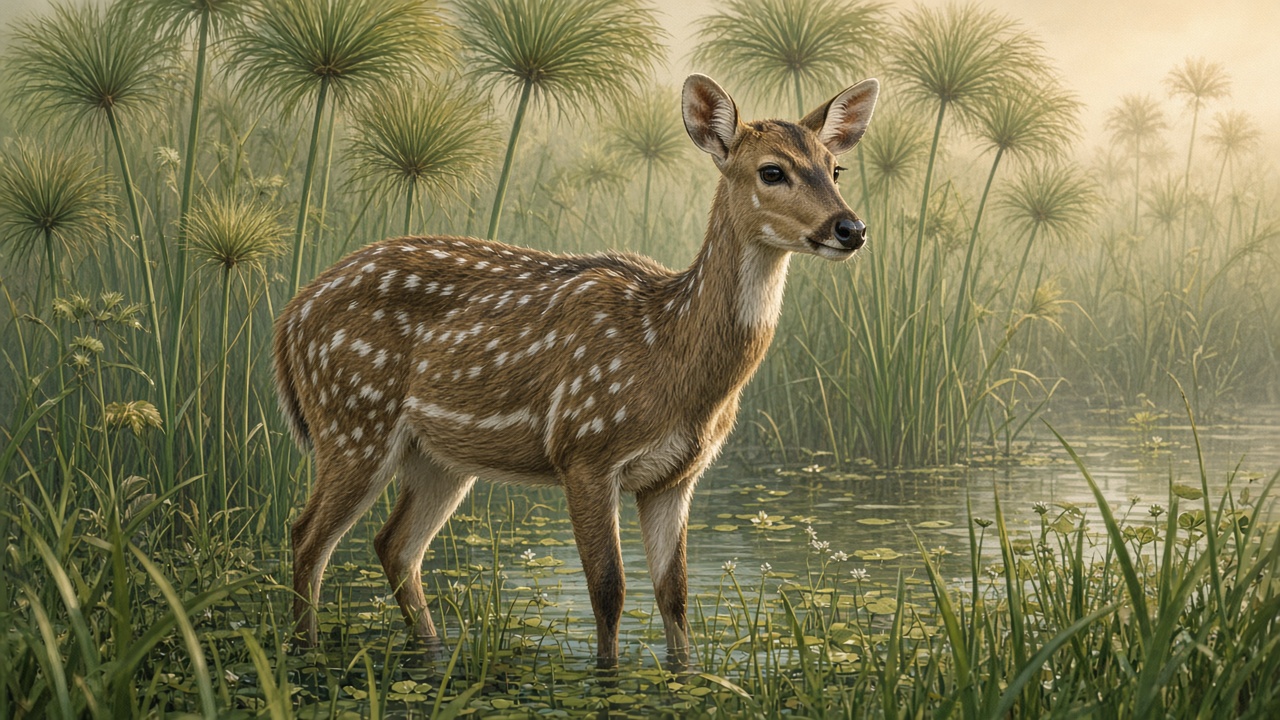
Sitatunga (Tragelaphus spekii): coexistence sheet across its documented range — presence, biology and prudence, without an invented hunting status.
Seen in: Namibia
Overview
Sitatunga (Tragelaphus spekii) is a coexistence sheet across its documented range: presence, biology and prudence — not a hunting status claim.
Classification: order Artiodactyla, family Bovidae, genus Tragelaphus. Common names: Sitatunga in English, Sitatunga in French, Sitatunga in Spanish.
Identification
A marsh antelope of 50 to 125 kg, the sitatunga is recognised by its very long, widely splayed hooves with naked pads and highly flexible foot joints, adapted to boggy ground. Males are much larger (100 cm at the shoulder against 75 to 90 cm) and grey-brown to chocolate brown; females are brown to bright chestnut. The coat is long, with whitish marks on the face, ears, cheeks, body and legs. Males carry horns 51 to 92 cm long with two twists and ivory tips. It closely resembles the nyala, differing in coat and hooves.
It breeds year-round; females give birth to a single young on average every 11.6 months after about 247 days of gestation. The calf is hidden on a platform of dry reeds in deep water. Semi-social, non-territorial and sedentary, it can reach 55 animals per km²; females form groups while adult males avoid one another. Active by day and night, it eats flowering plants while standing in water up to its shoulders, and comes out at night to graze on nearby dry land. Lions, wild dogs and leopards prey on it.
Habitats and range
MDD describes a patchy range: swamps in Gambia, western Guinea, Guinea-Bissau and southern Senegal, then rainforest and swamps of central and eastern Africa, from Cameroon and Lake Chad to western Kenya, Tanzania, Zambia, northern Botswana and the Caprivi Strip. Highly specialised, it lives only in swamps and permanent marshes, preferably with papyrus and Phragmites, and uses their deepest parts.
The countries where the species’ presence is established are shown in the tags on this sheet.
Field signs
It moves through the swamp along established paths branching off to foraging areas and riverine forest, and lies on vegetation platforms it tramples down by circling. It is sometimes seen standing in water chewing the cud. Males often bark at night; females have a higher-pitched bark. When chased, it can submerge with only its nostrils and eyes above water.
Conservation
For conservation status of Tragelaphus spekii, consult the current IUCN assessment and cross with national monitoring programmes in countries of documented presence. Never turn a global IUCN category into a local hunting rule. GBIF occurrences help situate distribution but remain effort-biased.
The IUCN lists it as Least Concern. Its regular paths make it highly vulnerable to snaring. MDD includes the forms sylvestris, larkenii, gratus and selousi, which Groves and Grubb (2011) treated as distinct; its presence in Ghana was only recently confirmed, and it is extinct in the Niger part of Lake Chad. It is a common host of the blood fluke Schistosoma.
Limits
This sheet on the Sitatunga covers presence and biology. A species being present in a country does not mean it may be hunted, and no season or quota is published here.
Local densities and management plans are not covered here: they are a matter for the managers of each area.
Sources
Sources consulted for this sheet:
- IUCN Red List — species search (consulted 2026-11-02)
- ASM Mammal Diversity Database — Tragelaphus spekii (consulted 2026-11-02)
- GBIF — species search (consulted 2026-11-02)
- Animal Diversity Web — Tragelaphus spekii (sitatunga) (consulted 2026-11-04)
Conclusion
In short: use the scientific name Tragelaphus spekii to cross-check sources, confirm taxonomy and conservation status on the institutional portals listed above, and relate every field sign to the habitat where it was actually found.
Identification
Tragelaphus spekii
Sitatunga · preferred
Sitatunga · preferred
Sitatunga · preferred
East African Sitatunga
Marsh Buck
Lake Victoria Sitatunga
Nkosi Island Sitatunga
Western Sitatunga
Western Marsh Buck
Nile Sitatunga
Nile Marsh Buck
Zambezi Sitatunga
Selous's Sitatunga
Zambezi Marsh Buck
Classification
Class : Mammalia
Order : Artiodactyla
Family : Bovidae
Genus : Tragelaphus
Conservation
IUCN : LC
CITES : —
iucn · LC (global)
Habitat
Frequently asked questions
How do I recognise Sitatunga?
Use Tragelaphus spekii as the scientific anchor. A marsh antelope of 50 to 125 kg, the sitatunga is recognised by its very long, widely splayed hooves with naked pads and highly flexible foot joints, adapted to boggy ground. Males are much larger (100 cm at the shoulder against 75 to 90 cm) and grey-brown to chocolate brown; fe...
Where does Sitatunga typically live?
MDD describes a patchy range: swamps in Gambia, western Guinea, Guinea-Bissau and southern Senegal, then rainforest and swamps of central and eastern Africa, from Cameroon and Lake Chad to western Kenya, Tanzania, Zambia, northern Botswana and the Caprivi Strip. Highly specialised, it lives only in swamps and permanent marshes, preferably with papyrus and Ph...
What field signs help confirm Sitatunga?
It moves through the swamp along established paths branching off to foraging areas and riverine forest, and lies on vegetation platforms it tramples down by circling. It is sometimes seen standing in water chewing the cud. Males often bark at night; females have a higher-pitched bark. When chased, it can submerge with only its nostrils and eyes above water.