Sun Bear
Helarctos malayanusNo solid country presence documented yet.
Sun Bear (Helarctos malayanus): coexistence sheet across its documented range — presence, biology and prudence, without an invented hunting status.
Overview
Sun Bear (Helarctos malayanus) is a coexistence sheet across its documented range: presence, biology and prudence — not a hunting status claim.
Classification: order Carnivora, family Ursidae, genus Helarctos. Common names: Sun Bear in English, Ours malais in French, Oso malayo in Spanish.
Identification
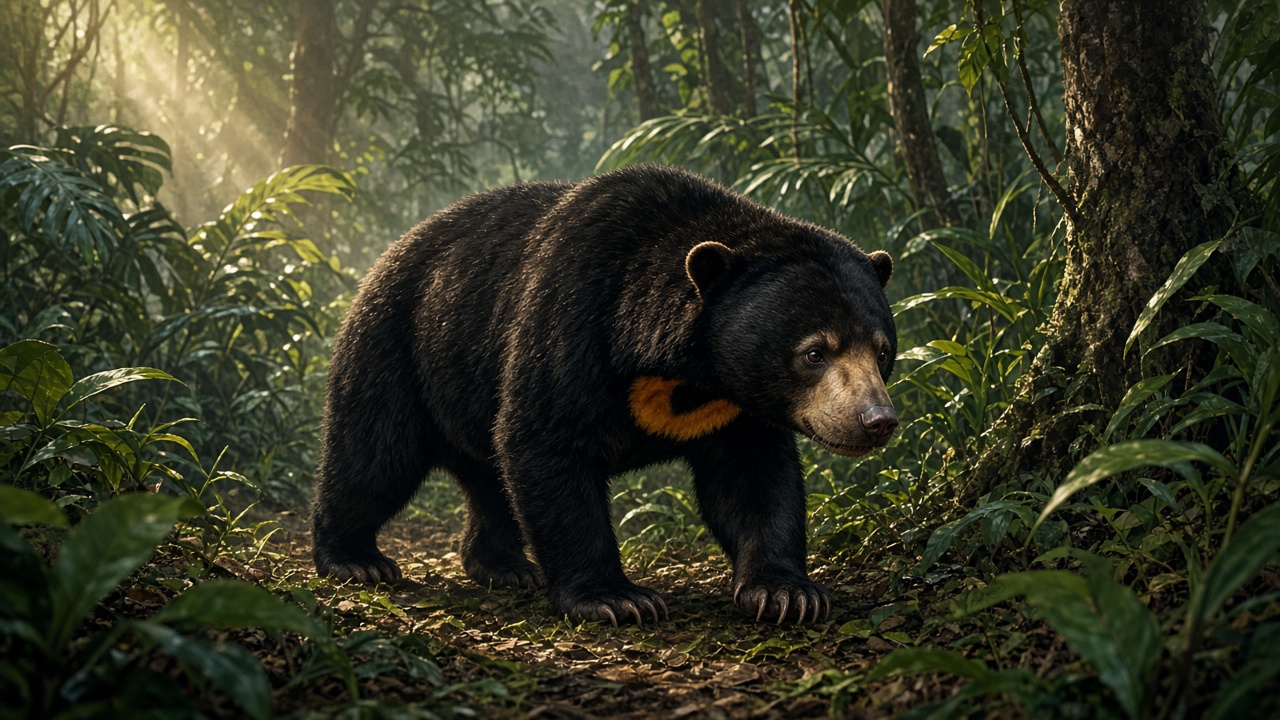
The sun bear is the smallest bear: about 70 cm at the shoulder, 1.2 to 1.5 m long, with a 3 to 7 cm tail and a weight of 27 to 65 kg. The head is short, wide and flat, with small round ears. The coat, fairly coarse but sleek-looking, is entirely black apart from a grey to faintly orange muzzle and a yellowish or white U-shaped chest patch that varies a lot and is sometimes absent. The large paws have sickle-shaped claws and naked soles; males are 10 to 20% larger than females.
An opportunistic omnivore, it lives mainly on bees, termites and earthworms, plus fruit when available; its long tongue helps it extract insects and honey. It occasionally takes small rodents, birds and lizards and scavenges tiger kills. Nocturnal and solitary, it does not hibernate. Breeding occurs year-round; litters are of one or two cubs, occasionally three, born blind and hairless at about 300 g. Young bears may be killed by tigers or by other sun bears.
Habitats and range
MDD lists it from Bangladesh, Brunei, Cambodia, India, Indonesia (Sumatra, Kalimantan), Laos, Malaysia, Myanmar, Thailand and Vietnam, with its presence in China uncertain. ADW describes a range from the eastern Himalayas to Sichuan, then south through Myanmar, parts of Indochina and the Malay Peninsula. It lives in dense lowland tropical forest, where it spends much time climbing trees.
The countries where the species’ presence is established are shown in the tags on this sheet.
Field signs
An excellent climber, it sleeps and sunbathes in trees at heights of 2 to 7 m. It walks with all four legs turned inwards, a distinctive gait. Torn-open termite nests, raided bee hives and trees dug into for insects and honey reveal its foraging. Near settlements it can damage oil palms, coconut palms and bananas.
Conservation
For conservation status of Helarctos malayanus, consult the current IUCN assessment and cross with national monitoring programmes in countries of documented presence. Never turn a global IUCN category into a local hunting rule. GBIF occurrences help situate distribution but remain effort-biased.
The IUCN lists it as Vulnerable and it is on CITES Appendix I. Its numbers are poorly known but declining because forests are cleared for plantations, notably rubber and oil palm, and poaching, including inside reserves. Its gall bladder is sought for folk medicine, although it has no proven medicinal value, and cubs are sold as pets. It disperses the seeds of many plants.
Limits
This sheet on the Sun Bear covers presence and biology. A species being present in a country does not mean it may be hunted, and no season or quota is published here.
Local densities and management plans are not covered here: they are a matter for the managers of each area.
Sources
Sources consulted for this sheet:
- IUCN Red List — species search (consulted 2026-11-02)
- ASM Mammal Diversity Database — Helarctos malayanus (consulted 2026-11-02)
- GBIF — species search (consulted 2026-11-02)
- Animal Diversity Web — Helarctos malayanus (sun bear) (consulted 2026-11-04)
Conclusion
In short: use the scientific name Helarctos malayanus to cross-check sources, confirm taxonomy and conservation status on the institutional portals listed above, and relate every field sign to the habitat where it was actually found.
Identification
Helarctos malayanus
Sun Bear · preferred
Ours malais · preferred
Oso malayo · preferred
Malayan Sun Bear
Dog Bear
Honey Bear
Classification
Class : Mammalia
Order : Carnivora
Family : Ursidae
Genus : Helarctos
Conservation
IUCN : VU
CITES : —
iucn · VU (global)
Frequently asked questions
How do I recognise Sun Bear?
Use Helarctos malayanus as the scientific anchor. The sun bear is the smallest bear: about 70 cm at the shoulder, 1.2 to 1.5 m long, with a 3 to 7 cm tail and a weight of 27 to 65 kg. The head is short, wide and flat, with small round ears. The coat, fairly coarse but sleek-looking, is entirely black apart from a grey to faintly...
Where does Sun Bear typically live?
MDD lists it from Bangladesh, Brunei, Cambodia, India, Indonesia (Sumatra, Kalimantan), Laos, Malaysia, Myanmar, Thailand and Vietnam, with its presence in China uncertain. ADW describes a range from the eastern Himalayas to Sichuan, then south through Myanmar, parts of Indochina and the Malay Peninsula. It lives in dense lowland tropical forest, where it sp...
What field signs help confirm Sun Bear?
An excellent climber, it sleeps and sunbathes in trees at heights of 2 to 7 m. It walks with all four legs turned inwards, a distinctive gait. Torn-open termite nests, raided bee hives and trees dug into for insects and honey reveal its foraging. Near settlements it can damage oil palms, coconut palms and bananas.