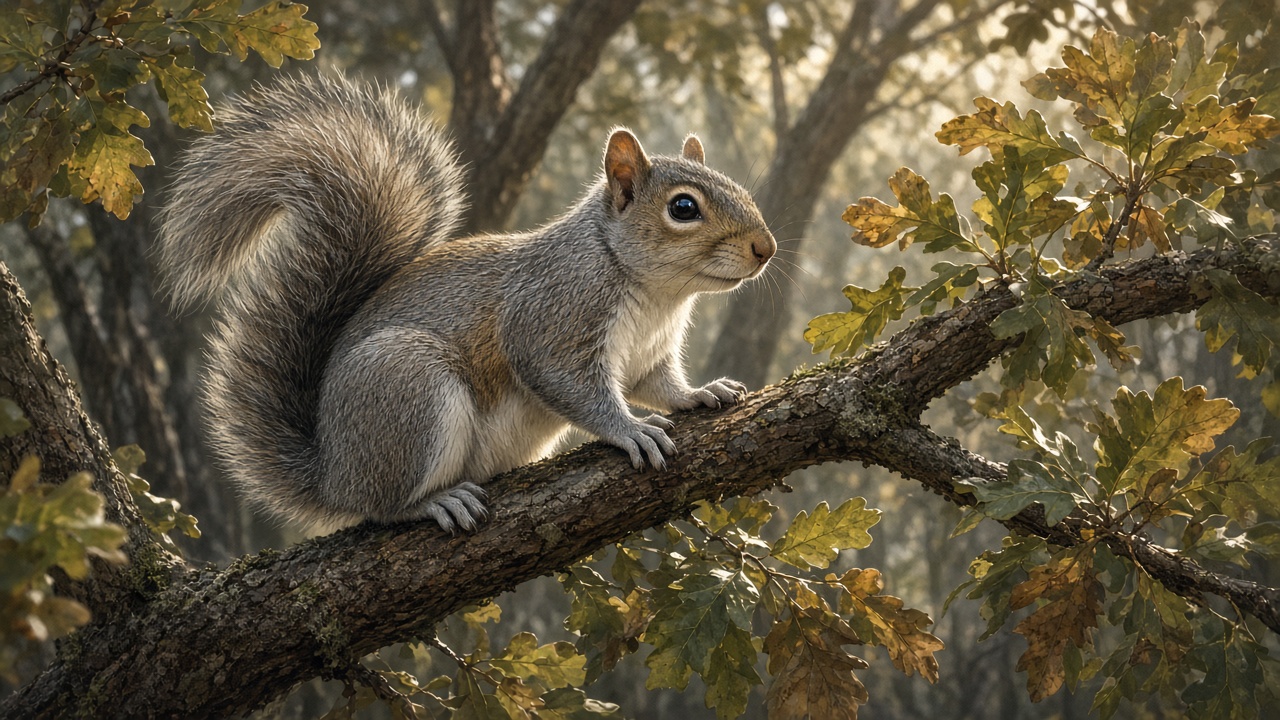
Western Gray Squirrel (Sciurus griseus): ecology sheet across its documented range — natural history and habitats, without hunting framing.
Seen in: United States
Overview
Western Gray Squirrel (Sciurus griseus) is an ecology sheet across its documented range: natural history and habitats, without any hunting framing.
Classification: order Rodentia, family Sciuridae, genus Sciurus. Common names: Western Gray Squirrel in English, Écureuil gris de l'Ouest in French, Ardilla gris occidental in Spanish.
Identification
A tree squirrel about 46 to 61 cm long including the tail, weighing 350 to 950 g. The back is silver grey and the belly white; the long, bushy tail, of the same grey, may be mixed with black. The ears are large and lack tufts, unlike those of its close relative, Abert’s squirrel. It moults once in late spring and again in early autumn, but the tail fur is shed only in the spring moult. MDD also gives the English name Silver Gray Squirrel.
Diurnal, it divides its time out of the nest between grooming (3 to 15 minutes, mostly the head), exploring, gathering food and resting. Its diet follows the habitat: pine-cone seeds in conifer forest, nuts and acorns in hardwood forest, plus berries, fungi, bark, sap and insects. It buries surplus food and relocates these caches by smell, mainly in winter. It does not hibernate. It breeds once a year in late spring: after about 43 days, 3 to 5 hairless young are born with eyes closed and are weaned at about ten weeks.
Habitats and range
MDD gives it from central Washington and western Oregon through California and a small part of Nevada to Baja California Norte, Mexico. It lives in woodland and conifer forest up to 2,500 m and dens in hollow trees or in stick nests. Its home range covers 0.5 to 7 ha, generally larger in males.
The countries where the species’ presence is established are shown in the tags on this sheet.
Field signs
Its stick nests, lined with moss, can be seen in trees. It forages on the ground as well as in the branches and opens hard seeds and nuts with its incisors. When threatened it gives barking calls while flicking its tail and stamping. It is territorial only when a female is in oestrus, and spends much less time outside during the colder months.
Conservation
For conservation status of Sciurus griseus, consult the current IUCN assessment and cross with national monitoring programmes in countries of documented presence. Never turn a global IUCN category into a local hunting rule. GBIF occurrences help situate distribution but remain effort-biased.
The IUCN lists it as Least Concern. ADW adds that it is a United States species of concern but not listed under the Endangered Species Act; the Washington subspecies, S. g. griseus, was proposed for endangered status in 2002, and the species is listed as threatened in Washington State and sensitive in Oregon. MDD notes a possible move, with S. aberti, to the genus Hesperosciurus, not adopted for now.
Limits
This sheet on the Western Gray Squirrel covers biology and ecology only; it publishes no hunting season, quota or authorisation.
Local densities and management plans are not covered here: they are a matter for the managers of each area.
Sources
Sources consulted for this sheet:
- IUCN Red List — species search (consulted 2026-11-02)
- ASM Mammal Diversity Database — Sciurus griseus (consulted 2026-11-02)
- GBIF — species search (consulted 2026-11-02)
- Animal Diversity Web — Sciurus griseus (western gray squirrel) (consulted 2026-11-04)
Conclusion
In short: use the scientific name Sciurus griseus to cross-check sources, confirm taxonomy and conservation status on the institutional portals listed above, and relate every field sign to the habitat where it was actually found.
Identification
Sciurus griseus
Écureuil gris de l'Ouest · preferred
Ardilla gris occidental · preferred
Western Gray Squirrel · preferred
Silver Gray Squirrel
Classification
Class : Mammalia
Order : Rodentia
Family : Sciuridae
Genus : Sciurus
Conservation
IUCN : LC
CITES : —
iucn · LC (global)
Habitat
Frequently asked questions
How do I recognise Western Gray Squirrel?
Use Sciurus griseus as the scientific anchor. A tree squirrel about 46 to 61 cm long including the tail, weighing 350 to 950 g. The back is silver grey and the belly white; the long, bushy tail, of the same grey, may be mixed with black. The ears are large and lack tufts, unlike those of its close relative, Abert’s squirrel....
Where does Western Gray Squirrel typically live?
MDD gives it from central Washington and western Oregon through California and a small part of Nevada to Baja California Norte, Mexico. It lives in woodland and conifer forest up to 2,500 m and dens in hollow trees or in stick nests. Its home range covers 0.5 to 7 ha, generally larger in males.
What field signs help confirm Western Gray Squirrel?
Its stick nests, lined with moss, can be seen in trees. It forages on the ground as well as in the branches and opens hard seeds and nuts with its incisors. When threatened it gives barking calls while flicking its tail and stamping. It is territorial only when a female is in oestrus, and spends much less time outside during the colder months.