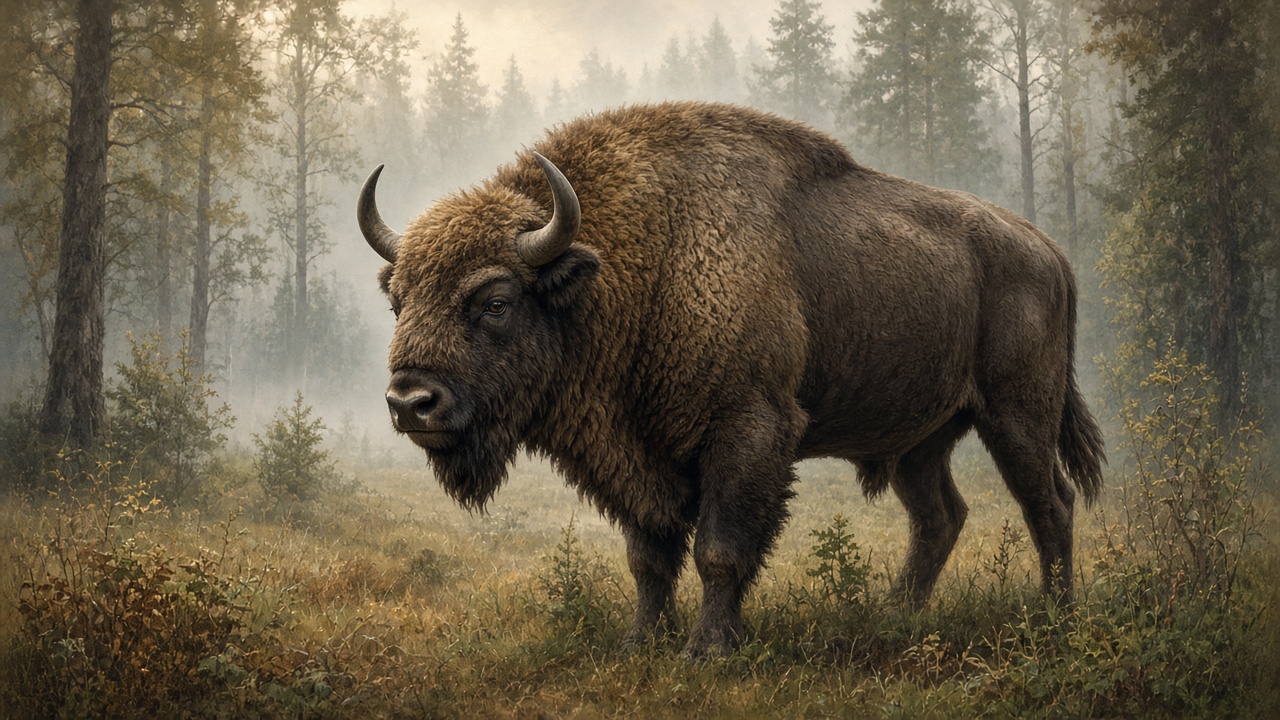
Wisent
Bos bonasusWisent (Bos bonasus): coexistence sheet across its documented range — presence, biology and prudence, without an invented hunting status.
Seen in: Bulgaria · Germany · Latvia · Lithuania · Poland
Overview
Wisent (Bos bonasus) is a coexistence sheet across its documented range: presence, biology and prudence — not a hunting status claim.
Classification: order Artiodactyla, family Bovidae, genus Bison. Common names: Wisent in English, Bison d'Europe in French, Bisonte europeo in Spanish.
Identification
The European bison, or wisent, is Europe’s largest native herbivore: about 2.9 m long, 1.8 to 1.95 m tall and usually 800 to 1,000 kg. It looks like the American bison but is shorter in stature, with a longer mane on the forehead and under the neck and a less shaggy coat ranging from golden brown to dark brown. The hump, formed by the spinal processes of the thoracic vertebrae wrapped in powerful muscle, is more developed in males; sexual dimorphism becomes marked at about three years and lasts for life.
About 90% of its diet is grasses, sedges and herbs, topped up with roughly 10% twigs and bark from trees and shrubs. Active by day, it alternates foraging, resting and rumination; in summer, foraging takes up 60% of its activity. The rut runs from July to October; after 254 to 277 days of gestation, the cow leaves the herd for a few days to give birth to a single calf, mostly from May to July. It has no natural predators: disease and injury are the main causes of death.
Habitats and range
Once widespread in the lowlands of Europe, from the Pyrenees to southern Sweden and the Caucasus, it died out in the wild through overhunting and habitat loss; MDD notes that it survived in Poland until the early 20th century. Reintroduced from captive stock, it now lives in central and eastern Europe (including Poland, Belarus, Lithuania, Russia, Ukraine, Slovakia and Romania). It uses broad-leaved or mixed forest in a mosaic with open ground: mown meadows, grassy glades, clear-cuts and young plantations.
The countries where the species’ presence is established are shown in the tags on this sheet.
Field signs
Active by day, it shows up as mixed groups averaging 8 to 13 animals (cows, two- to three-year-olds, calves and adult bulls), sometimes up to 23 in open areas; over half of the bulls live alone. In winter, bison gather in large groups around hay racks. Crop damage also reveals herds in farmland-dominated landscapes.
Conservation
For conservation status of Bos bonasus, consult the current IUCN assessment and cross with national monitoring programmes in countries of documented presence. Never turn a global IUCN category into a local hunting rule. GBIF occurrences help situate distribution but remain effort-biased.
According to ADW, the IUCN lists the species as Vulnerable; MDD shows it as Not Evaluated under the name Bos bonasus. The whole current population descends from 12 founders: heavy inbreeding lowers breeding success and disease resistance. Habitat fragmentation, poaching and hybridisation with American bison in the Caucasus add to the threats. MDD places the species in the genus Bos, within which both bison species are nested, and includes the form caucasicus.
Limits
This sheet on the Wisent covers presence and biology. A species being present in a country does not mean it may be hunted, and no season or quota is published here.
Local densities and management plans are not covered here: they are a matter for the managers of each area.
Sources
Sources consulted for this sheet:
- IUCN Red List — species search (consulted 2026-11-02)
- ASM Mammal Diversity Database — Bos bonasus (consulted 2026-11-02)
- GBIF — species search (consulted 2026-11-02)
- Animal Diversity Web — Bison bonasus (European bison) (consulted 2026-11-04)
Conclusion
In short: use the scientific name Bos bonasus to cross-check sources, confirm taxonomy and conservation status on the institutional portals listed above, and relate every field sign to the habitat where it was actually found.
Identification
Bos bonasus
Wisent · preferred
Bison d'Europe · preferred
Bisonte europeo · preferred
European Bison
European Wisent
Caucasian Wisent
Caucasian Bison
Dombay
Bison bonasus
Classification
Class : Mammalia
Order : Artiodactyla
Family : Bovidae
Genus : Bison
Conservation
IUCN : NT
CITES : —
iucn · NT (global)
Habitat
Frequently asked questions
How do I recognise Wisent?
Use Bos bonasus as the scientific anchor. The European bison, or wisent, is Europe’s largest native herbivore: about 2.9 m long, 1.8 to 1.95 m tall and usually 800 to 1,000 kg. It looks like the American bison but is shorter in stature, with a longer mane on the forehead and under the neck and a less shaggy coat ranging...
Where does Wisent typically live?
Once widespread in the lowlands of Europe, from the Pyrenees to southern Sweden and the Caucasus, it died out in the wild through overhunting and habitat loss; MDD notes that it survived in Poland until the early 20th century. Reintroduced from captive stock, it now lives in central and eastern Europe (including Poland, Belarus, Lithuania, Russia, Ukraine, S...
What field signs help confirm Wisent?
Active by day, it shows up as mixed groups averaging 8 to 13 animals (cows, two- to three-year-olds, calves and adult bulls), sometimes up to 23 in open areas; over half of the bulls live alone. In winter, bison gather in large groups around hay racks. Crop damage also reveals herds in farmland-dominated landscapes.