- Family
- Fixed ground stand
- Difficulty
- Moderate: the stand is known, but keeping the site supplied, identifying animals in poor light and following local rules take rigour
- Organisation
- Alone, sometimes in pairs, on ground managed by whoever holds the hunting rights
- Key gear
- Bright binoculars, a fixed stand, a zeroed rifle, kit to mark the shot site
- Season
- Set species by species and region by region: the competent authority publishes the periods
- Who it suits
- Patient hunters who manage ground and accept a strict regulatory framework
What is the idea behind baited stand hunting?
Three practices are often confused. Supplementary feeding spreads grain to hold animals in woodland and keep them off crops; baiting puts food at one exact spot to bring an animal in front of a stand; fodder feeding helps animals through a shortage. Only baiting is directly linked to the shot, and each country regulates all three in its own way.
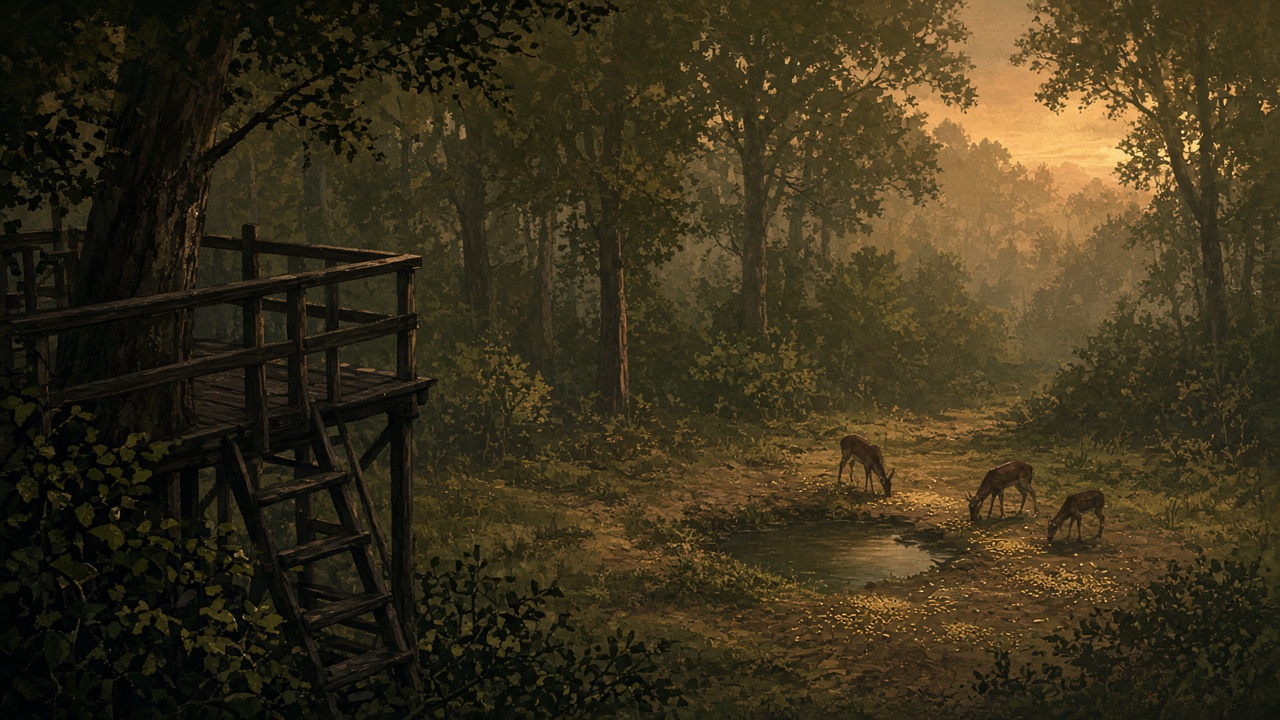
The key is routine: the site is topped up at the same place, and animals get used to calling in. The stand, often a high seat or a ground hide, sits a short distance away, downwind, with a safe backstop. The long wait lets you watch the animals before choosing, for instance to tell a sow followed by her piglets from a lone animal.
The practice is debated. Supporters see it as a way to shoot a calm animal at short range after identifying it properly; critics point to changes in movement patterns and the concentration of animals. Animal-health authorities also note that feeding points bring wild boar together, which matters for preventing African swine fever.
How does baited stand hunting work in the field?
What equipment do you need for baited stand hunting?
- A container or feeder suited to the type of food allowed
- Very bright binoculars and, where the law allows, optics designed for low light
- Gloves for handling bait without leaving scent on it
- A stable seat or rest that lets you stay still for a long time
Safety rules for baited stand hunting
- Shoot only an animal you have fully identified, with lighting that complies with the law
- Remember that a bait site can also draw curious walkers or dogs: make sure no person or pet is nearby before shooting
- Stay in the stand after the shot and go to the animal only once you are sure it is no longer moving
- Work out in daylight, from the stand itself, which shooting directions are safe and which are not
Common mistakes in baited stand hunting
- Topping up irregularly, which makes visits unpredictable
- Shooting the first animal that arrives without waiting to see the rest of the group
- Assuming that what is allowed in one region is allowed in the next
- Settling in with the wind carrying your scent towards where game is expected
Which species are hunted by baited stand hunting?
Where is baited stand hunting practised?
Germany
Baited stand hunting is known in German as Kirrung: small amounts of food draw game, mainly wild boar, to a shooting stand. Federal law leaves it to the federal states to ban feeding or make it subject to approval, so the rules differ from one state to another. Under federal law wild boar may be shot at night, but artificial lights and night sights are banned unless a state provides otherwise.
Bavaria (Germany)
In Bavaria, feeding hoofed game outside times of hardship is as a rule treated as improper, except for diversionary feeding of wild boar, and only food suited to the species is allowed. Bavarian law exempts Kirrungen (baiting sites) from the ban on shooting hoofed game near feeding places and allows lights and night sights for wild boar.
North Rhine-Westphalia (Germany)
In North Rhine-Westphalia, no Kirrung (baiting site) or stand may be set up less than 75 metres from the boundary of a neighbouring shoot, unless the neighbours agree in writing or the authority grants an exemption. The state ministry may lay down by regulation which baits and installations are allowed, and night shooting is permitted only for wild boar and predators.
Namibia
In Namibia, the regulations on predator trophy hunting (cheetah, leopard, lion) allow baiting but forbid the use of a live animal as bait. Such hunts need a specific permit obtained beforehand and carried by the guide during the hunt; leopard also requires a quota tag.
South Africa
In South Africa, the national TOPS Regulations prohibit luring a listed threatened or protected species with bait, sound or smell, except for dead bait for lion, leopard and hyena. For unlisted species such as warthog, baiting is governed by provincial rules.
Limpopo (South Africa)
In Limpopo province, hunting a cheetah, hyena, leopard, lion or African wild dog that has been lured by bait or by sound requires a permit. The 2003 provincial Act does not set this restriction for other species.
Northern Cape (South Africa)
In the Northern Cape, the 2009 Act prohibits hunting a wild animal by luring it with bait, scent, sound or any other induced lure, unless a permit is held and its conditions are met.
Spain — Castilla y León
In Spain, aguardo over a cebadero (bait site) is common for wild boar, often at night by moonlight where regulations allow. Each autonomous community sets its own rules on bait sites, hours and lighting; the community’s official gazette and the regional federation explain the framework in force.
Sweden
Fixed lighting at a bait site (åtel) is allowed only for wild boar. Thermal sights may be used only in open terrain or at bait sites.
Rules vary by country and region: check with the local authority. See the sources
Baited stand hunting compared with neighbouring techniques
Baited stand hunting is a particular form of stand hunting: the stand relies not only on a natural route but on food put out. A high seat often serves as the stand. Where permitted, the bow is frequently used over bait because the animal comes close. In France, supplementary feeding is governed by departmental game-management plans.
Key terms in baited stand hunting
- bait site
- A spot where food is placed to draw an animal close to a stand.
- supplementary feeding
- Putting out grain or other food to hold or feed game; it is regulated in many countries.
- fodder feeding
- Putting out hay or other fodder to help game through a shortage, as distinct from feeding grain or baiting.
- stand hunting
- Waiting motionless at a chosen spot on a game trail or near an area that game uses.
- high seat
- A raised stand, fixed or portable, from which the hunter watches and shoots down towards the ground.
- shot site
- Where the animal stood when it was shot; the starting point of the search.
- professional hunter (PH)
- A licensed guide who runs the hunt and is responsible for the client in the field.
Frequently asked questions about baited stand hunting
What is baited stand hunting?
It is waiting at a fixed stand near a spot where grain or bait is put out regularly, so that game comes in within short range.
What is the difference between feeding, baiting and fodder?
Supplementary feeding spreads grain to hold or divert animals, baiting concentrates food in front of a stand, and fodder feeding helps animals through a shortage. Their legal status differs from country to country.
Is hunting over bait permitted everywhere?
No. It is permitted, regulated or banned depending on the country, the region and sometimes the species. In Spain the autonomous communities set the rules; in South Africa, the provinces.
How is feeding linked to African swine fever?
Feeding points bring wild boar together and increase contact between them. In affected areas, animal-health authorities may restrict feeding and ask for carcasses to be reported.
Can you shoot at a bait site at night?
Only where the law allows it. Night shooting, lights and night-vision aids are regulated separately in each country or region and must be checked before going out.
Why watch for a long time before shooting?
Because several animals often arrive together. Waiting lets you spot young, a sow with piglets or a sick animal, and choose a shot that puts no other animal in the group at risk.
Baited stand hunting in pictures
Sources and references on baited stand hunting
- Boletín Oficial del Estado (BOE) — Legislación estatal y autonómica de caza (consulted on )
- Real Federación Española de Caza (RFEC) — Modalidades, licencias y federaciones autonómicas (consulted on )
- Department of Forestry, Fisheries and the Environment (DFFE) — Biodiversity, hunting and permits in South Africa (consulted on )
- Professional Hunters’ Association of South Africa (PHASA) — Professional hunting in South Africa (consulted on )
- Ministère de l’Agriculture — Peste porcine africaine : mesures de prévention (consulted on )
- Légifrance — Code de l’environnement, livre IV, titre II : chasse
- Bundesministerium der Justiz (gesetze-im-internet.de) — Bundesjagdgesetz (BJagdG), § 28 Sonstige Beschränkungen in der Hege (al. 5 : affouragement du gibier, compétence des Länder) (consulted on )
- Boletín Oficial del Estado (BOE) — Ley 4/2021, de 1 de julio, de Caza y de Gestión Sostenible de los Recursos Cinegéticos de Castilla y León (texto consolidado) : arts. 32-40, 50-51 y anexo III (modalidades) (consulted on )
- Government Gazette of the Republic of Namibia n° 4416 (hébergé par le Legal Assistance Centre) — GN 9 of 2010 : règl. 114A à 114C, chasse au trophée des prédateurs (conditions du règl. 114C(5)) (consulted on )
- Sveriges riksdag — Jaktförordning (1987:905), 14 §, 14 a §, 17 §, 19 § et 20 § (consulted on )
- Department of Forestry, Fisheries and the Environment (DFFE) — NEMBA : Threatened or Protected Species Regulations, 2007 (GN R152, Gazette 29657), règl. 12, 21 et 26 (consulted on )
- Province du Cap-Nord (texte publié par Laws.Africa / lawlibrary.org.za) — Northern Cape Nature Conservation Act 9 of 2009, art. 9 (méthodes de chasse prohibées sans permis) et art. 27 (consulted on )
- Bayerische Staatskanzlei (gesetze-bayern.de) — Verordnung zur Ausführung des Bayerischen Jagdgesetzes (AVBayJG), § 23a Mißbräuchliche Wildfütterung (consulted on )
- Land Nordrhein-Westfalen (recht.nrw.de) — Landesjagdgesetz Nordrhein-Westfalen (LJG-NRW), version consolidée publiée sur recht.nrw.de (consulted on )
- Province du Limpopo (texte reproduit par FAOLEX, FAO) — Limpopo Environmental Management Act 7 of 2003, art. 31(1)(f), 38(2)(d) et 50 (consulted on )
Practice information — not a legal authorisation.