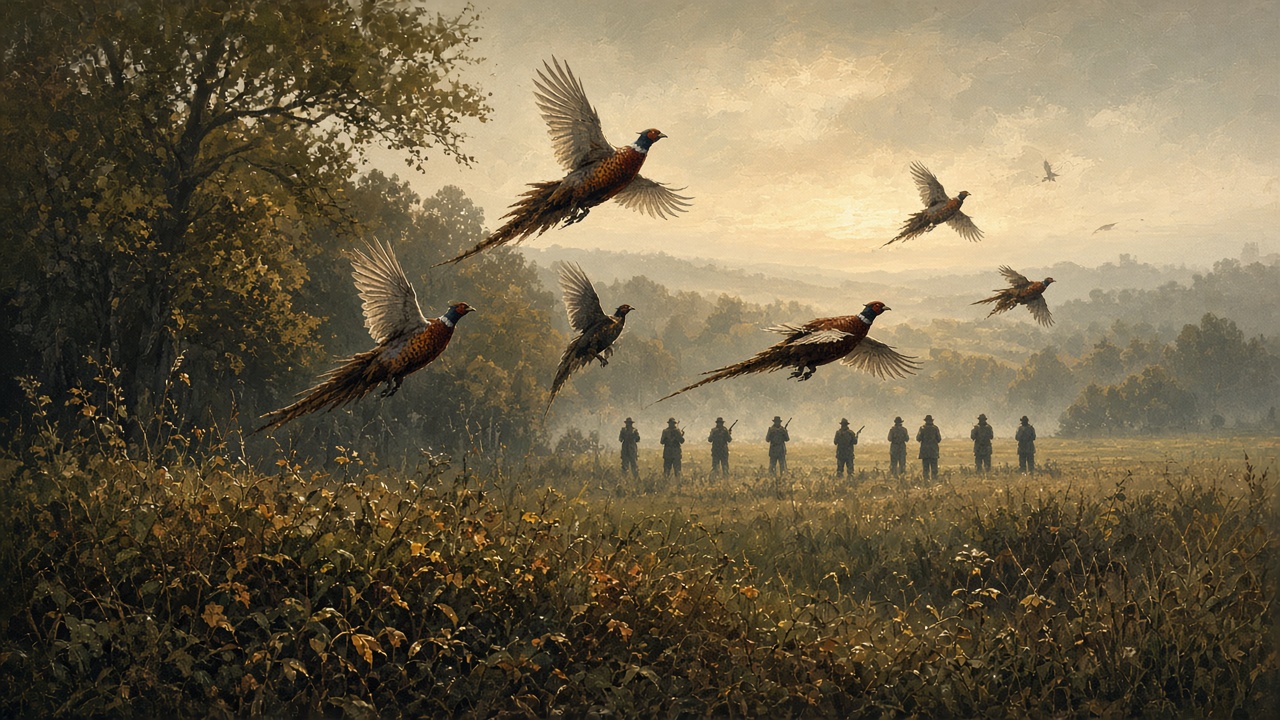
- Family
- Collective game-bird shooting
- Difficulty
- Moderate: shooting high and crossing birds, line discipline, constant awareness of neighbours
- Organisation
- An organised day: standing guns, beaters, pickers-up with dogs and someone in charge
- Key gear
- A shotgun, suitable cartridges, ear defenders, a cartridge bag, a retriever or pickers-up
- Season
- Varies by species and country: check with the departmental federation in France, the autonomous community in Spain or the British shooting bodies
- Who it suits
- Confident game shots who enjoy shared shooting days
What is the idea behind driven game-bird shooting?
The idea is the drive, applied to birds. Beaters, sometimes helped by flushing dogs, work a field or wood towards the line of guns, which is often placed behind a hedge, below a wood or across a valley. Birds rise ahead of them and cross the line at height. Organisers aim to show high, fast birds rather than large numbers, which makes the shooting harder and keeps shots well above people.
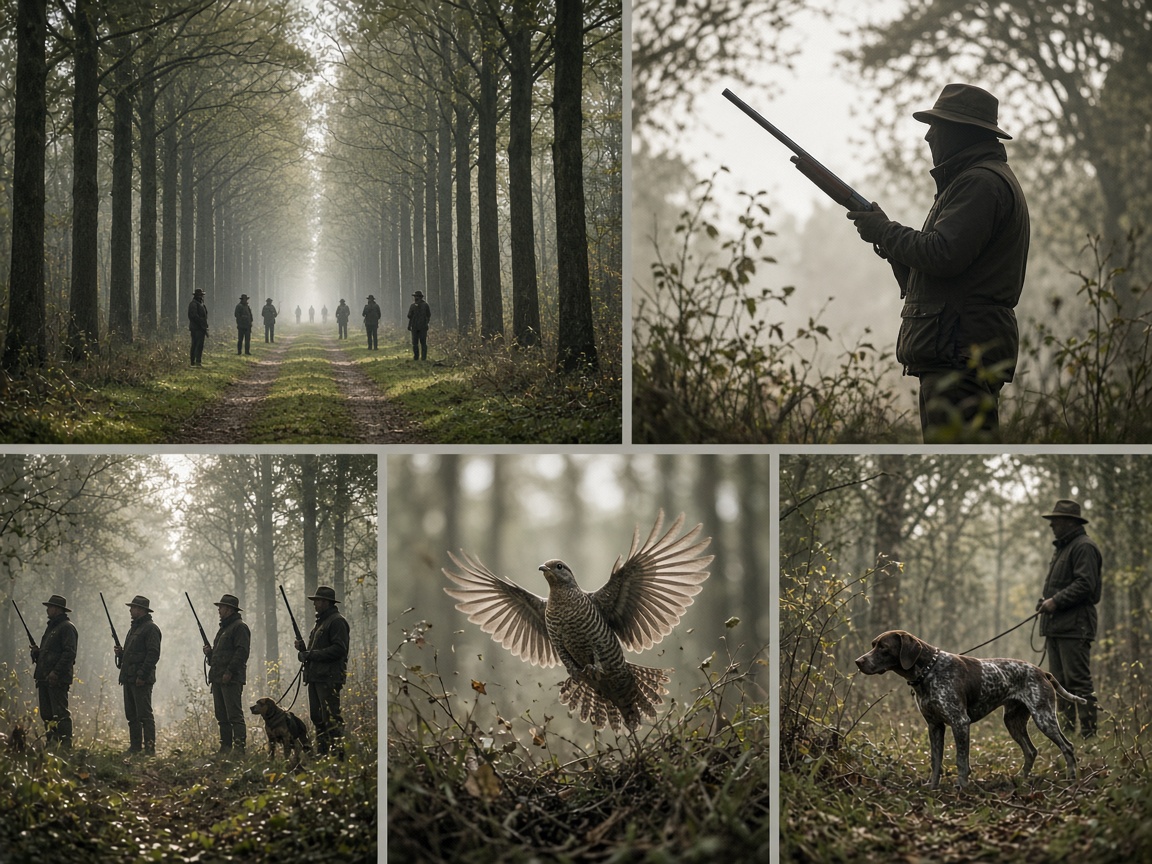
Each gun stands at a numbered position allocated at the start of the day; on many shoots the numbers move on between drives so that everyone changes place. You shoot in front while birds are coming, then behind once they have crossed, lifting the gun upright to turn instead of swinging it towards your neighbours. Behind the line, pickers-up with retrievers collect fallen birds and look for wounded ones.
On many shoots, some of the pheasants and partridges come from game farms and were released before the season. Releasing reared birds is regulated differently from country to country and is debated for its effects; in the United Kingdom the GWCT publishes research and guidance on the subject. The bag, counted by species at the end of the day, helps the shoot keep track of its ground.
How does driven game-bird shooting work in the field?
What equipment do you need for driven game-bird shooting?
- A shotgun suited to driven birds, and cartridges that comply with the rules on lead shot, which is banned over wetlands in the European Union and regulated by each nation in the United Kingdom
- A cartridge bag or belt, and thin gloves that keep feeling in your hands
- A gun slip to carry the shotgun between drives
- Ear defenders and shooting glasses
Safety rules for driven game-bird shooting
- Lift the gun upright to turn and take a bird behind, rather than swinging along the line
- Shoot only at a bird with clear sky around it, never into a hedge, wood or ridge that may hide beaters or pickers-up
- Keep the gun open and unloaded between drives and when moving, including in vehicles
- Never swing through the line of neighbouring pegs while following a bird
Common mistakes in driven game-bird shooting
- Shooting a bird too close, which spoils it, instead of letting it gain distance
- Claiming a neighbour’s birds or poaching the ones heading for them
- Not marking where your birds fall, which makes the pickers-up search for longer
- Taking a low bird at the height of beaters or neighbours
Which species are hunted by driven game-bird shooting?
Where is driven game-bird shooting practised?
England
In England, this form of shooting is the driven shoot, with its pegs, beaters and pickers-up, described on its own page. Releasing pheasants or red-legged partridges on or within 500 metres of a special area of conservation or special protection area requires a Natural England licence. The general lead shot restriction adopted in 2026 applies from 1 April 2029, subject to derogations.
France
In France, driven pheasant and partridge shooting takes place mainly on private shoots in open farmland and hedged country, often with released birds. Quarry species, releases and safety rules come under the Environment Code and each department’s game management scheme; the departmental federation and the OFB explain them. Grey partridge is covered by management plans in some departments.
Germany
In Germany, driven small-game shooting takes place in field Treibjagden (drive hunts), collective shotgun hunts in which guns, beaters and dogs work together. The German Hunting Association (DJV) distinguishes three field forms: the Kesseltreiben, the Vorstehtreiben and the Böhmische Streife.
Scotland
In Scotland, driven game-bird shooting takes place for pheasant and partridge on sporting estates and for red grouse on the moor. Since the Wildlife Management and Muirburn (Scotland) Act 2024, any land where red grouse are shot must be covered by a NatureScot licence, whose holder must have regard to the code of practice on grouse moor management. The general lead restriction adopted in 2026 also applies in Scotland from 1 April 2029, subject to derogations.
Spain — Castilla y León
In Spain, the traditional form is the ojeo of red-legged partridge: ojeadores, the beaters, drive the birds towards a line of stands hidden behind screens called pantallas. Each gun may be helped by a secretario, who assists and marks fallen birds, and sometimes by a loader. Ojeos are held mainly on the plains and hills of central and southern Spain; rules are set by the autonomous communities.
Rules vary by country and region: check with the local authority. See the sources
Driven game-bird shooting compared with neighbouring techniques
Driven game-bird shooting differs from big-game drive hunting in weapon and quarry: shotguns and birds in flight instead of rifles and animals on the ground. The driven shoot is its codified British form, with its own vocabulary and organisation, and the ojeo is its Spanish form. In walked-up hunting, by contrast, the hunters walk the ground themselves to flush game. Retriever work is part of both driven and walked-up days.
Regional forms of driven game-bird shooting
- Driven shooting in the UK Driven shooting is the British game-bird shooting day: beaters drive pheasants, partridges or grouse over a line of guns standing at numbered pegs.
Key terms in driven game-bird shooting
- stand (peg)
- The position allocated to a hunter on a drive; called a peg on British driven shoots.
- beater
- A person who walks through the drive to flush game towards the guns.
- picker-up
- A handler who works retrievers behind the line to collect shot and wounded birds.
- retriever
- A dog trained to find and bring back shot game to hand, on land or from water.
- flushing dog
- A dog such as a spaniel that hunts cover close to the gun and flushes game within shotgun range.
- ojeo
- The Spanish driven shoot for red-legged partridge, with beaters pushing birds towards a line of stands hidden behind screens (pantallas).
- driven shoot
- A shooting day in which birds are driven over a line of numbered pegs.
- bag
- The total of game shot during a day, counted by species at the end of shooting.
Frequently asked questions about driven game-bird shooting
What is driven game-bird shooting?
It is shotgun shooting in which beaters flush pheasants, partridges or pigeons and drive them over a line of standing guns, who shoot them in flight.
Why do shoots aim for high birds?
A high bird stands out against the sky, well away from beaters and neighbours, and is shot at a range that does not spoil it. It is also harder to hit, which many guns enjoy.
What do pickers-up do?
Standing behind the line with retrievers, they collect fallen birds and, above all, find wounded ones quickly, during and after the drive.
Are the birds released?
On many shoots some pheasants and partridges come from game farms. Rules on releasing and monitoring them vary by country; the GWCT publishes work on their effects in the United Kingdom.
Can you shoot a hare on a bird drive?
That depends on the instructions of the day and on local rules. Many organisers ban ground game to protect dogs and beaters.
How does it differ from a British driven shoot?
The principle is the same. The driven shoot is the British form, with its own customs, vocabulary and reference bodies; the ojeo is the Spanish form, centred on red-legged partridge.
Driven game-bird shooting in pictures
Sources and references on driven game-bird shooting
- Office français de la biodiversité (OFB) — Chasse, permis de chasser et police de l’environnement (consulted on )
- Fédération nationale des chasseurs (FNC) — Chasseur de France : pratiques, sécurité et fédérations départementales (consulted on )
- Légifrance — Code de l’environnement, livre IV, titre II : chasse
- Boletín Oficial del Estado (BOE) — Legislación estatal y autonómica de caza (consulted on )
- Real Federación Española de Caza (RFEC) — Modalidades, licencias y federaciones autonómicas (consulted on )
- Game & Wildlife Conservation Trust (GWCT) — Game and wildlife research (consulted on )
- Code of Good Shooting Practice — The Code of Good Shooting Practice (consulted on )
- British Association for Shooting and Conservation (BASC) — Shooting advice and codes of practice (consulted on )
- BASC — Lead ammunition (consulted on )
- EUR-Lex — Règlement (UE) 2021/57 sur le plomb dans les munitions en zones humides (consulted on )
- GWCT — Compliance with the law on the use of non-lead ammunition (consulted on )
- legislation.gov.uk — REACH (Amendment) Regulations 2026, SI 2026/195 : restriction du plomb dans les munitions (consulted on )
- Deutscher Jagdverband (DJV) — Bewegungsjagd (Drückjagd, Treibjagd) (consulted on )
- Boletín Oficial del Estado (BOE) — Ley 4/2021, de 1 de julio, de Caza y de Gestión Sostenible de los Recursos Cinegéticos de Castilla y León (texto consolidado) : arts. 32-40, 50-51 y anexo III (modalidades) (consulted on )
- Légifrance — Code de l'environnement, article L425-2 : contenu obligatoire du schéma départemental de gestion cynégétique (sécurité, lâchers, recherche au sang, agrainage) (consulted on )
- Defra et Natural England (GOV.UK) — Gamebirds: licences to release them (England) (consulted on )
- legislation.gov.uk — Wildlife Management and Muirburn (Scotland) Act 2024, section 10 : licence NatureScot pour les terres où la grouse est tirée (section 16AA WCA 1981) (consulted on )
Practice information — not a legal authorisation.