European Wildcat
Felis silvestrisEuropean Wildcat (Felis silvestris): coexistence sheet across its documented range — presence, biology and prudence, without an invented hunting status.
Seen in: Austria · Belgium · Bulgaria · Croatia · Czechia
Overview
European Wildcat (Felis silvestris) is a coexistence sheet across its documented range: presence, biology and prudence — not a hunting status claim.
Classification: order Carnivora, family Felidae, genus Felis. Common names: European Wildcat in English, Chat sauvage in French, Gato montés europeo in Spanish.
Identification
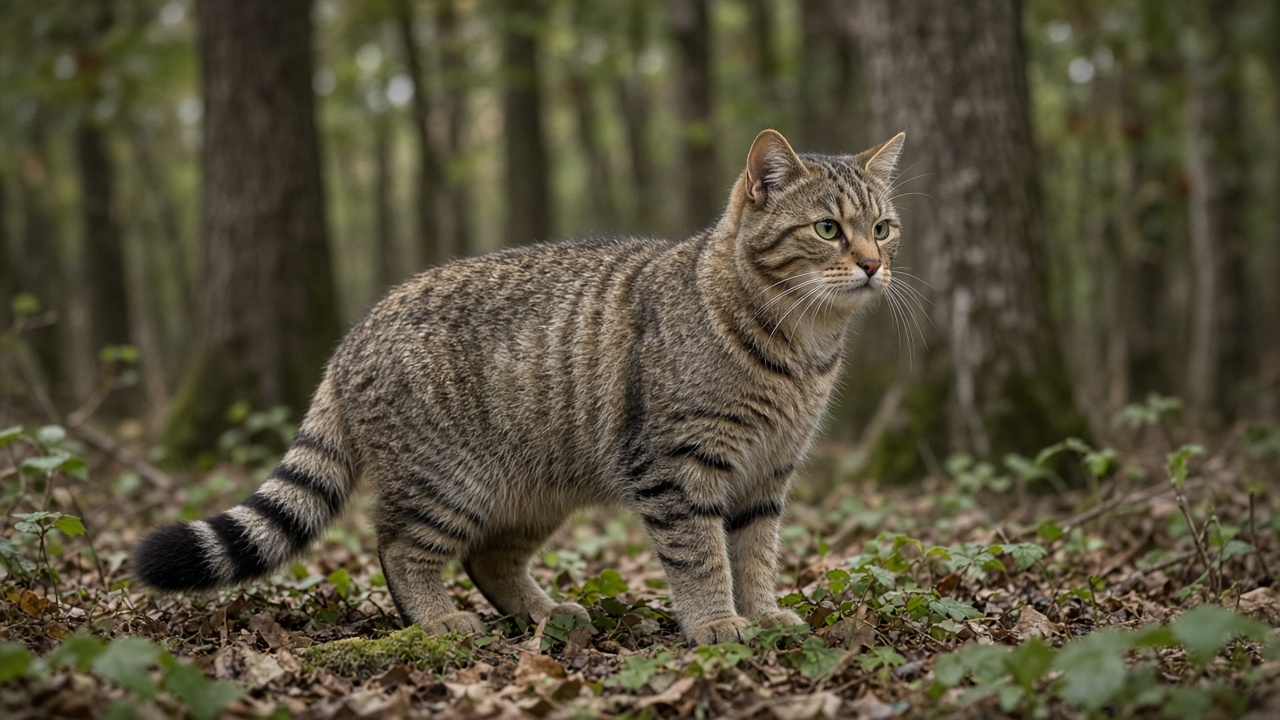
The wildcat looks like a tabby domestic cat of about the same size: 50 to 75 cm head and body, with a 21 to 35 cm tail. European females average 3.5 kg and males 5 kg, though weight varies considerably through the year. The short, soft, grey-brown coat bears a well-defined pattern of black stripes over the whole body, and the tail is bushy; the thick winter fur makes it look bulkier. Males are larger than females. There are five toes on each forefoot and four on each hind foot, with retractile claws.
Solitary, it is mostly active at night or at dawn and dusk, more so by day where disturbance is low; one European wildcat was recorded travelling 10 km in a night. It mainly hunts small rodents, and rabbits seem to be the dominant prey in Europe; it also takes birds, reptiles, amphibians, eggs and large insects, occasionally scavenges and caches food. Mating takes place from January to March and births mostly in May: 1 to 8 kittens after 56 to 68 days of gestation, in a shelter under rocks or in dense vegetation. Foxes, wolves and birds of prey take young cats.
Habitats and range
MDD lists it from Europe, the Caucasus and Turkey; the country list includes France, Spain, Portugal, Italy, Germany, Belgium and the United Kingdom. ADW notes that in the British Isles it survives only in Scotland and that it is absent from Scandinavia. It lives mainly in deciduous forest, more marginally in coniferous forest, and also in scrubland, riparian habitats, coastal areas and extensively grazed farmland. It cannot persist where more than 20 cm of snow lies for over 100 days in winter.
The countries where the species’ presence is established are shown in the tags on this sheet.
Field signs
Very secretive, it is hard to spot in woodland thanks to its striped coat. Males mark their range by spraying strong-smelling urine and rub objects with scent glands on the forehead, around the mouth and near the base of the tail. When a female comes into oestrus, several males gather nearby, screeching, yowling, displaying and fighting. Confusion with a tabby domestic cat is easy: a bushy tail and crisp black stripes are the features described for the species.
Conservation
For conservation status of Felis silvestris, consult the current IUCN assessment, then cross with French monitoring programmes when they exist (OFB portal and related publications). Never turn a global IUCN category into a departmental hunting rule. GBIF occurrences help situate documented distribution but remain effort-biased.
The IUCN lists it as Least Concern. It was largely exterminated from western and central Europe in the 19th and 20th centuries; it is recovering in parts of its former range but remains threatened by habitat loss, population isolation, road deaths, diseases from domestic cats and, above all, hybridisation with them. According to MDD, the species formerly included F. lybica, the African wildcat from which the domestic cat descends.
Limits
This sheet on the European Wildcat covers presence and biology. A species being present in a country does not mean it may be hunted, and no season or quota is published here.
Local densities and management plans are not covered here: they are a matter for the managers of each area.
Sources
Sources consulted for this sheet:
- IUCN Red List — species search (consulted 2026-11-01)
- ASM Mammal Diversity Database — Felis silvestris (consulted 2026-11-01)
- GBIF — species search (consulted 2026-11-01)
- Animal Diversity Web — Felis silvestris (wild cat) (consulted 2026-11-04)
Conclusion
In short: use the scientific name Felis silvestris to cross-check sources, confirm taxonomy and conservation status on the institutional portals listed above, and relate every field sign to the habitat where it was actually found.
Identification
Felis silvestris
European Wildcat · preferred
Chat sauvage · preferred
Gato montés europeo · preferred
Caucasian Wildcat
Classification
Class : Mammalia
Order : Carnivora
Family : Felidae
Genus : Felis
Conservation
IUCN : LC
CITES : —
iucn · LC (global)
Habitat
Frequently asked questions
How do I recognise European Wildcat?
Use Felis silvestris as the scientific anchor. The wildcat looks like a tabby domestic cat of about the same size: 50 to 75 cm head and body, with a 21 to 35 cm tail. European females average 3.5 kg and males 5 kg, though weight varies considerably through the year. The short, soft, grey-brown coat bears a well-defined patter...
Where does European Wildcat typically live?
MDD lists it from Europe, the Caucasus and Turkey; the country list includes France, Spain, Portugal, Italy, Germany, Belgium and the United Kingdom. ADW notes that in the British Isles it survives only in Scotland and that it is absent from Scandinavia. It lives mainly in deciduous forest, more marginally in coniferous forest, and also in scrubland, riparia...
What field signs help confirm European Wildcat?
Very secretive, it is hard to spot in woodland thanks to its striped coat. Males mark their range by spraying strong-smelling urine and rub objects with scent glands on the forehead, around the mouth and near the base of the tail. When a female comes into oestrus, several males gather nearby, screeching, yowling, displaying and fighting. Confusion with a tab...