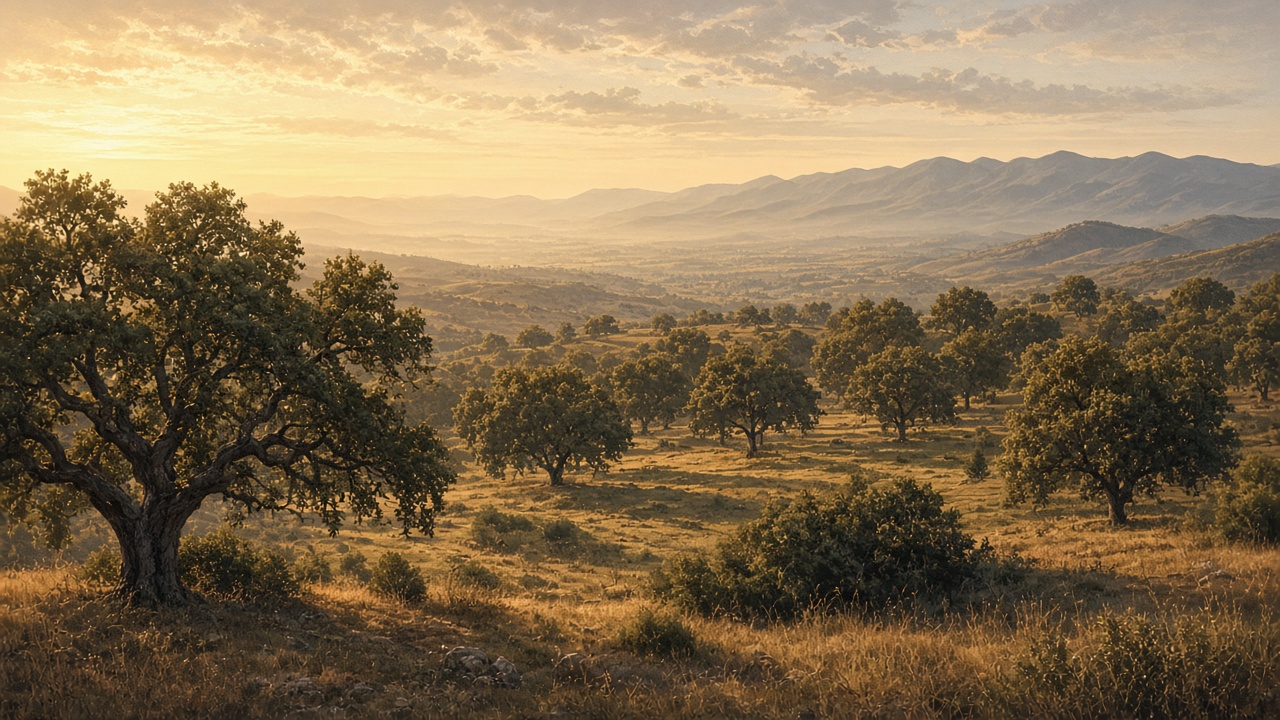
Spain — hunting and nature
Dehesa, Doñana, matorral and Cantabrian forest.
Overview
Spain takes up most of the Iberian peninsula, from the Pyrenees to Andalusia. The dehesa, the matorral, Doñana and the Cantabrian forests are not described with the same species.
The Meseta and the Guadiana organise the interior. The Pyrenees and the Cantabrian range close the north. Doñana and the Tablas de Daimiel are wetlands. Almería opens an arid end that is not the dehesa.
Habitats
Mediterranean forest, matorral, mountain, dehesa farmland, the Doñana wetland, coast, Cantabrian temperate forest, riverbank and the aridity of Almería are the Spanish settings to link. Dehesa is stated with farmland: it has no code of its own.
Fauna followed on this sheet
Iberian ibex, Iberian hare, chamois and wild boar structure separate ranges and dehesas. Golden jackal has only isolated records, with no population. Harbour seal is not established on the Spanish coasts. Grey seal is occasional. Alpine marmot was introduced in the Pyrenees.
How the country is read
Montería and a mountain stalk are read by autonomous community, from Andalusia to Cantabria. This national page does not turn them into a calendar and does not mix them with the montaria of Portugal.
What this sheet does not state
The Spanish page publishes no season, quota, fee or weapon. The dated text of the autonomous community governs for Doñana as for the Pyrenees.
Sources
Institutional pages consulted for Spain. Open the live page before any operational use.
- Ministerio para la Transición Ecológica (MITECO) (consulted 2026-11-02)
- GBIF — country ES (consulted 2026-11-02)
Before a field reading
For Spain, name the community and the setting. The dehesa, Doñana, the matorral and the Cantabrian forest do not fit in one list.
Habitats
Species
Documented presence at country level, with its status. No inheritance down to municipalities. Presence is not an authorisation.
Native
-
Brown Bear
Ursus arctos
-
Common Fallow Deer
Dama dama
-
Common Genet
Genetta genetta
-
Common Vole
Microtus arvalis
-
Egyptian Mongoose
Herpestes ichneumon
-
Eurasian Beaver
Castor fiber
-
Eurasian Otter
Lutra lutra
-
Eurasian Red Squirrel
Sciurus vulgaris
-
Eurasian Water Vole
Arvicola amphibius
-
Eurasian Wild Pig
Sus scrofa
-
European Badger
Meles meles
-
European Fat Dormouse
Glis glis
-
European Hare
Lepus europaeus
-
European Pine Marten
Martes martes
-
European Polecat
Mustela putorius
-
European Rabbit
Oryctolagus cuniculus
-
European Wildcat
Felis silvestris
-
Gray Wolf
Canis lupus
-
Iberian Hare
Lepus granatensis
-
Iberian Ibex
Capra pyrenaica
-
Least Weasel
Mustela nivalis
-
Red Fox
Vulpes vulpes
-
Roe deer
Capreolus capreolus
-
Southern Chamois
Rupicapra pyrenaica
-
Stoat
Mustela erminea
-
Stone Marten
Martes foina
-
Western Red Deer
Cervus elaphus
Introduced
-
Alpine Marmot
Marmota marmota
-
Roof Rat
Rattus rattus
Occasional
-
Golden Jackal
Canis aureus
-
Gray Seal
Halichoerus grypus
Techniques
- Stalking
- Stand hunting
- High-seat hunting
- Drive hunting
- Walked-up hunting
- Hunting with scent hounds
- Hunting over pointing dogs
- Hunting with retrievers
- Blood tracking with dogs
- Waterfowl hunting
- Waterfowl hide hunting
- Flight shooting
- Hunting with decoys and calls
- Driven game-bird shooting
- Falconry
- Bowhunting
- Ferreting
- Baited stand hunting
- Montería in Spain
- Iberian rececho
- Mountain hunting
Neighbouring countries
Frequently asked questions
What does the Spain sheet cover on Aunerys?
Dehesa, Doñana, matorral and Cantabrian forest.
Does this sheet state seasons, quotas or fees?
The Spanish page publishes no season, quota, fee or weapon. The dated text of the autonomous community governs for Doñana as for the Pyrenees.
Do listed species mean hunting is allowed?
Documented presence with a status is not an authorisation. National or regional rules decide what is lawful.