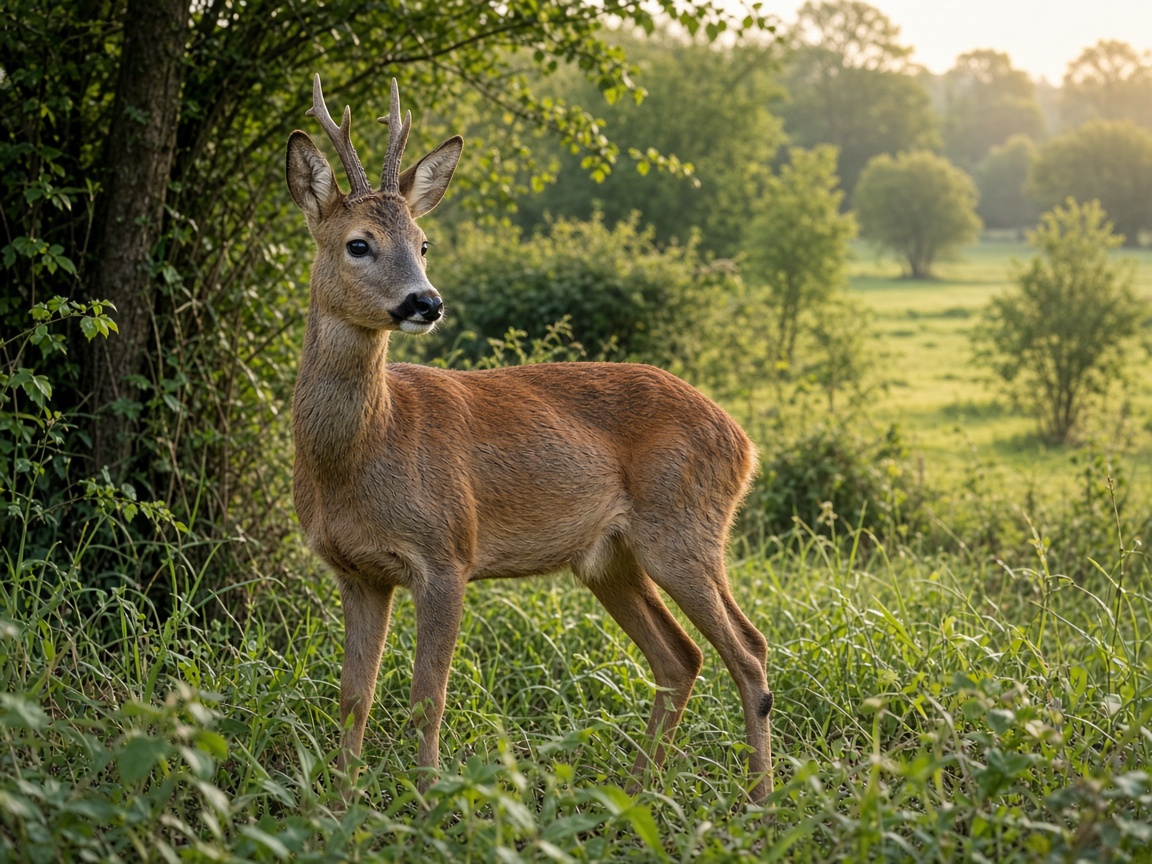
Roe deer
Capreolus capreolusRoe deer (Capreolus capreolus): biology, habitats and field signs across its documented range, hunting-context reading.
Seen in: Austria · Belgium · Bulgaria · Croatia · Czechia
Overview
Roe deer (Capreolus capreolus) is presented here in a hunting-context reading across its documented range: biology, habitats and field signs useful to observers — without publishing season, quota or authorisation.
Classification: order Artiodactyla, family Cervidae, genus Capreolus. Common names: Roe deer in English, Chevreuil in French, Corzo in Spanish.
Identification
The roe deer is a small, slender deer: 107 to 126 cm long, 66 to 83 cm at the shoulder and about 22 to 30 kg. The neck is long and maneless, the ears fairly large and the tail reduced to a 2 to 3 cm stub. The coat is bright reddish in summer and grey-brown to dark brown in winter, when a large white rump patch shows. Males, slightly larger than females, carry short, knobbly antlers, usually with three tines; fawns are spotted.
The rut takes place mainly from June to August, but the fertilised egg does not implant until January: the roe deer is the only ungulate with delayed implantation. Fawns are born from April to July, usually twins. Males cast their antlers in October–November and regrow them straight away. A selective feeder, it seeks soft, nutritious plants (herbs, woody shoots, fruit and seeds in autumn) and feeds five to eleven times a day. Its predators are wolf and lynx; foxes take fawns.
Habitats and range
It occurs across almost all of Europe except Corsica, Sardinia, Sicily and Ireland, east to western Russia, Turkey, the Caucasus and northern Iran. It prefers mosaics of woodland and farmland, small woods among fields, tall-grass meadows with shrubs, felled areas and regrowth. Solitary or in small family groups in summer, it gathers in winter, sometimes in groups of several dozen in open country.
The countries where the species’ presence is established are shown in the tags on this sheet.
Field signs
Narrow, short two-toed tracks, smaller than red deer; groups of oval pellets; low fraying on young trees, left by bucks on their territory; a short, sharp alarm bark. In winter, the conspicuous white rump patch often gives away a fleeing animal.
Conservation
For conservation status of Capreolus capreolus, consult the current IUCN assessment, then cross with French monitoring programmes when they exist (OFB portal and related publications). Never turn a global IUCN category into a departmental hunting rule. GBIF occurrences help situate documented distribution but remain effort-biased.
The IUCN lists it as Least Concern. After a marked decline and fragmentation of its range between the late 19th and early 20th centuries, its numbers and range have recovered; it is now the most abundant wild ungulate in Europe, with frequent road collisions where it is numerous.
Limits
This sheet on the Roe deer publishes no season, quota, hunting method or fee: those rules differ between countries and territories and must be checked in official texts. Being described here does not mean a species may be hunted.
Local densities and management plans are not covered here: they are a matter for the managers of each area.
Sources
Sources consulted for this sheet:
- IUCN Red List — species search (consulted 2026-11-01)
- ASM Mammal Diversity Database — Capreolus capreolus (consulted 2026-11-01)
- GBIF — species search (consulted 2026-11-01)
- Animal Diversity Web — Capreolus capreolus (western roe deer) (consulted 2026-11-04)
Conclusion
In short: use the scientific name Capreolus capreolus to cross-check sources, confirm taxonomy and conservation status on the institutional portals listed above, and relate every field sign to the habitat where it was actually found.
Identification
Capreolus capreolus
Chevreuil européen · preferred
Corzo · preferred
Western Roe Deer · preferred
Chevreuil · preferred
Roe deer · preferred
Corzo · preferred
European Roe Deer
Roe deer
Classification
Class : Mammalia
Order : Artiodactyla
Family : Cervidae
Genus : Capreolus
Conservation
IUCN : LC
CITES : —
iucn · LC (global)
Habitat
Practices
Frequently asked questions
How do I recognise Roe deer?
Use Capreolus capreolus as the scientific anchor. The roe deer is a small, slender deer: 107 to 126 cm long, 66 to 83 cm at the shoulder and about 22 to 30 kg. The neck is long and maneless, the ears fairly large and the tail reduced to a 2 to 3 cm stub. The coat is bright reddish in summer and grey-brown to dark brown in winter...
Where does Roe deer typically live?
It occurs across almost all of Europe except Corsica, Sardinia, Sicily and Ireland, east to western Russia, Turkey, the Caucasus and northern Iran. It prefers mosaics of woodland and farmland, small woods among fields, tall-grass meadows with shrubs, felled areas and regrowth. Solitary or in small family groups in summer, it gathers in winter, sometimes in g...
What field signs help confirm Roe deer?
Narrow, short two-toed tracks, smaller than red deer; groups of oval pellets; low fraying on young trees, left by bucks on their territory; a short, sharp alarm bark. In winter, the conspicuous white rump patch often gives away a fleeing animal.