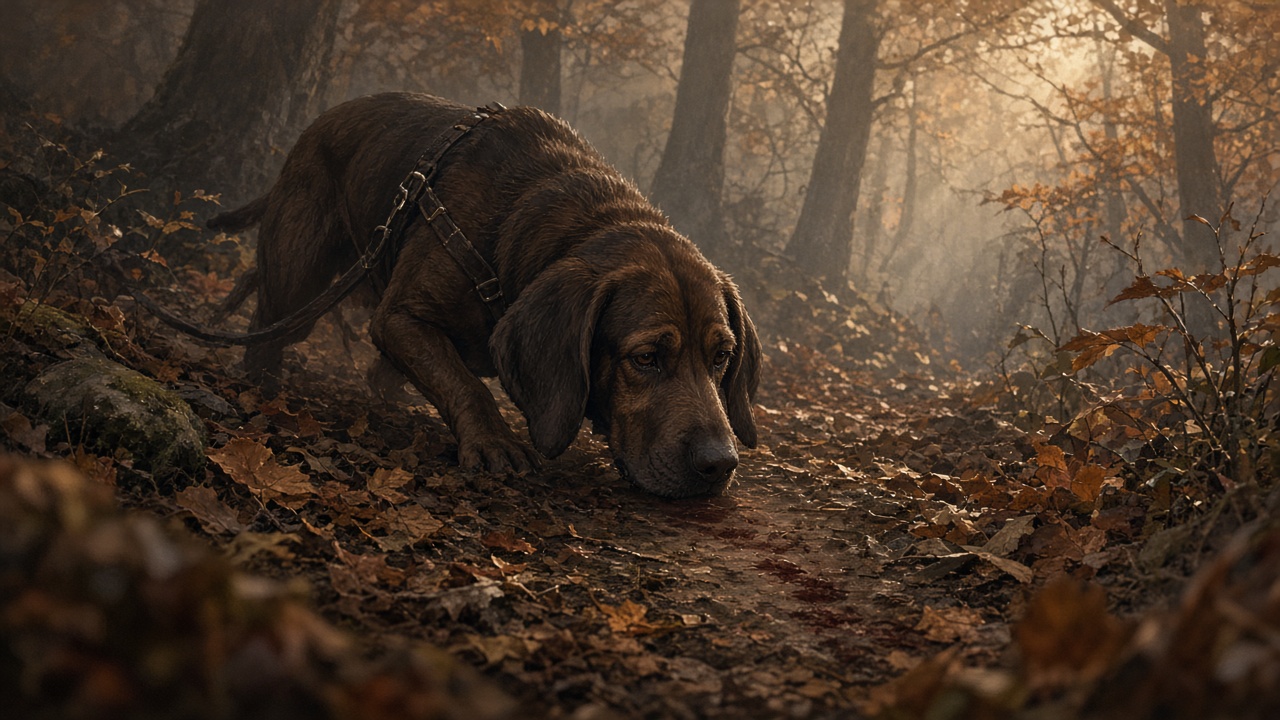
- Family
- Recovering wounded game
- Difficulty
- High for the handler: it takes a trained dog, experience in reading shot signs and good physical fitness
- Organisation
- A handler and dog, with the shooter and sometimes a companion
- Key gear
- A trained dog, a tracking lead and harness, marking tape, a torch, clothing that copes with thick cover
- Season
- Whenever big game is shot; the follow-up itself is governed by local rules: check with the relevant authority
- Who it suits
- Every big-game hunter, who should know how to call on a handler
What is the idea behind blood tracking?
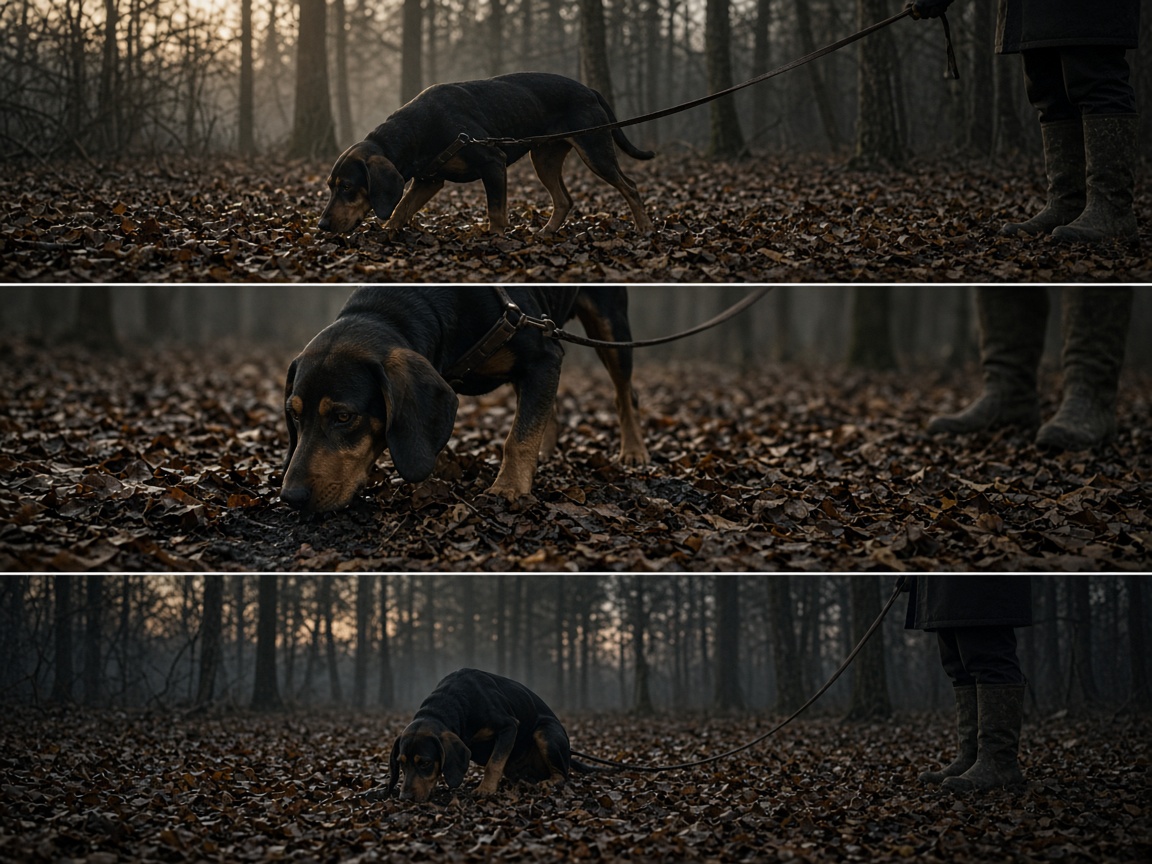
Blood tracking is not a way of hunting but the follow-up to it: it is used to find a wounded big-game animal, or to confirm that an animal shot at was not hit. It is carried out by a handler and a specially trained blood-tracking dog, worked on a tracking lead along the animal’s line, even when that line is no longer fresh.
The work begins at the moment of the shot. The shooter watches the animal’s reaction and the direction it runs, locates the shot site without trampling it and marks it. Shot signs found there, such as blood, hair or bone fragments, help the handler judge the wound and how to conduct the search; the handler also decides when to start, because a wounded animal followed too soon may get up and run a long way.
The dog follows the wounded animal’s line and ignores the lines of healthy animals it crosses. If the animal is found alive, the handler may slip the dog; how the animal is then dispatched, and whether a firearm may be carried during the search, depend on each country’s rules.
How does blood tracking work in the field?
What equipment do you need for blood tracking?
- A tracking lead and a harness or collar suited to the dog
- Clothing that stands up to brambles, as searches often go through dense undergrowth
- A charged phone with a handler’s number saved before the outing
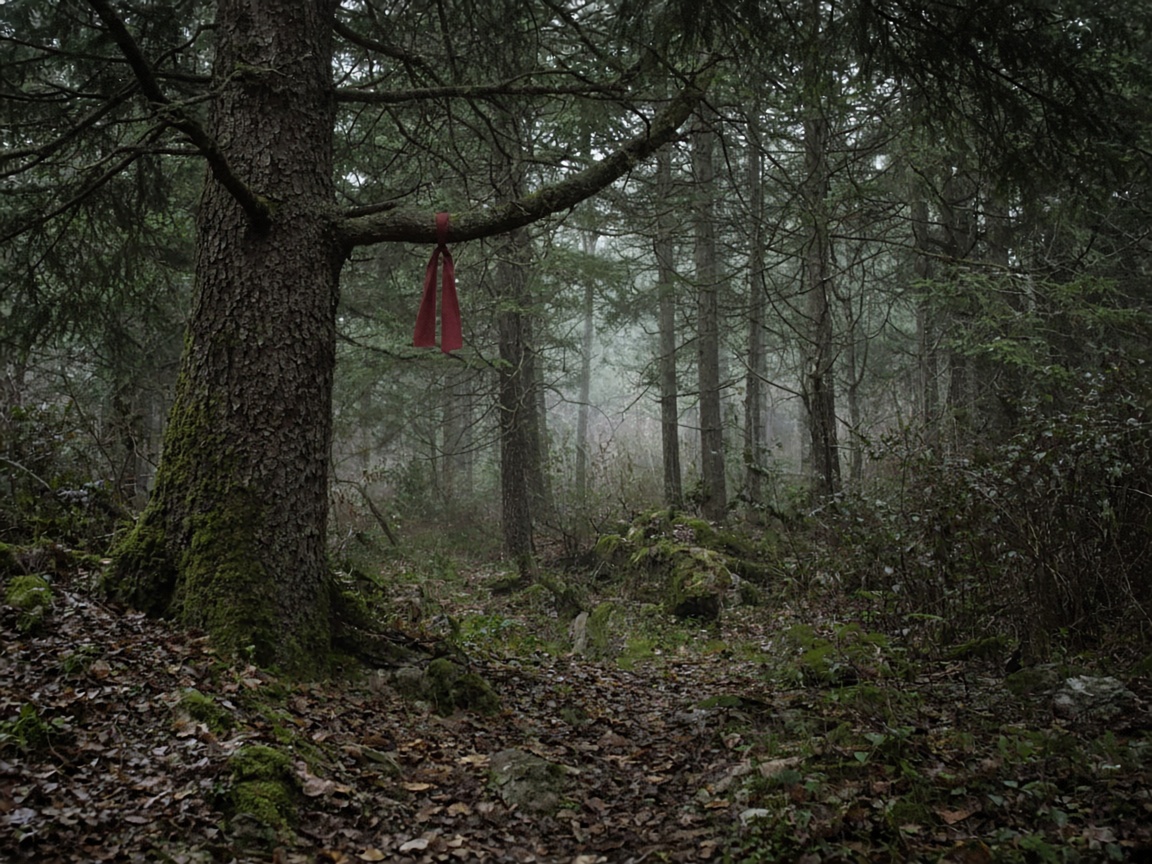
- A strong torch and marking tape for the trail
Safety rules for blood tracking
- Anyone with the handler stays behind them, with their firearm made safe, and shoots only if asked to
- Warn neighbouring hunters if the search crosses a boundary, and check the local rules on following up onto other ground
- Protect a dog slipped on a live boar: a protective vest and a quick intervention reduce the risk
- Approach a wounded animal with care: it may get up and charge
Common mistakes in blood tracking
- Following the animal yourself before the handler arrives, which spoils the line and may push the animal further
- Deciding too quickly that a shot missed without checking the shot site
- Calling a handler without being able to find the exact spot where the animal was shot
- Letting people trample the shot site before the handler arrives
Which species are hunted by blood tracking?
Where is blood tracking practised?
England
In England, a wounded deer is followed up with a trained dog, as the BASC and British Deer Society code recommends. The Hunting Act 2004 exempts searching for a wild mammal believed to be injured in order to relieve its suffering, provided no more than two dogs are used, never below ground, on land where one has permission or with a constable’s authority (Schedule 1, paragraph 8).
France
In France, UNUCR coordinates a national network of volunteer blood-tracking handlers who can be contacted after a shot at big game. The conditions under which they work, any approval they may need and whether they may carry a firearm during a search should be checked with UNUCR, the departmental hunting federation and the OFB.
Germany
Federal law requires wounded game to be killed without delay to spare it avoidable suffering; the Nachsuche (tracking wounded game with a specialist dog) is how it is found. Following a wounded animal onto a neighbouring shoot, the Wildfolge, requires a written agreement between the shoots, with the details set by each federal state.
Bavaria (Germany)
In Bavaria, the state hunting act adds to the federal rule an express duty to search for wounded game promptly and competently. It also forbids deliberately wounding an animal, in particular to train or test dogs.
North Rhine-Westphalia (Germany)
In North Rhine-Westphalia, neighbouring shoots must let the handler of a qualified blood-tracking dog cross their ground, carrying a firearm, and handlers from Schweißhundstationen (blood-tracking dog stations recognised by the authority) may continue the search if the neighbour cannot be reached. The hunter who wounded a hoofed animal must make himself available for the search.
Hungary
Wounded game must be searched for while there is a chance of finding it, and the shot site must be examined. Where needed, a tracking dog that has passed a blood-tracking test is called in.
Latvia
Before searching for a wounded elk, red deer, wild boar or roe deer, the wounding must be logged in the designated mobile app. Tracking dogs may be used all season.
Namibia
In Namibia, the 1975 Ordinance provides that game wounded by a shot fired under a trophy hunting permit counts as hunted under that permit. For predators hunted as trophies (cheetah, leopard, lion), the regulations forbid the use of dogs to track or hunt them.
Poland
The rules define the search for wounded game and require the shooter to carry it out. At a collective hunt it starts only after the drive, with the hunt leader’s consent.
Scotland
In Scotland, searching with dogs for a wild mammal believed to be injured falls under the Hunting with Dogs (Scotland) Act 2023: no more than two dogs, under control, with the landowner’s permission or under a statutory power of entry, and the animal must be treated, captured, shot or allowed to escape (section 7). Searching for a dead animal falls under section 8. The Wild Deer Best Practice guides cover reaction and follow-up and the use of dogs.
South Africa
In South Africa, the national TOPS Regulations generally prohibit hunting listed threatened or protected species with dogs, but allow dogs to be used to track a wounded animal. Provincial laws set their own conditions for other species.
Limpopo (South Africa)
In Limpopo province, the 2003 Act restricts hunting with dogs but allows a dog to be used to pursue a wild animal wounded during lawful hunting.
Northern Cape (South Africa)
In the Northern Cape, the 2009 Act prohibits hunting with a dog unless a permit is held, but allows a dog to be used to search for and follow a wounded animal, and for bird hunting.
Spain — Castilla y León
In Spain, blood tracking is called rastreo de sangre. Handlers and breed clubs offer this work, for instance after a montería or a rececho; the RSCE recognises the specialist breeds, and the applicable rules are set by the autonomous communities.
Sweden
For elk, deer, roe deer, mouflon, wild boar, bear and other species, a dog trained to track wounded game must be able to reach the shot site within two hours at most.
Alaska (United States)
Searching for wounded big game is allowed with a single leashed dog, which may also be used to dispatch it.
Rules vary by country and region: check with the local authority. See the sources
Blood tracking compared with neighbouring techniques
Blood tracking does not replace the hunt but follows it, after stalking, stand hunting or a drive. It differs from a retriever’s work: a retriever works free to collect small game that has fallen within sight, while a blood-tracking dog follows a wounded big-game animal’s line on a long lead, sometimes far from where it was shot.
Key terms in blood tracking
- blood-tracking dog
- A dog trained to find wounded big game, worked on a long lead by a handler.
- handler
- The person who works the tracking dog and decides how the search proceeds.
- tracking lead
- The long line on which the handler works a blood-tracking dog.
- shot site
- Where the animal stood when it was shot; the starting point of the search.
- shot signs
- Hair, blood, fragments or the animal’s reaction that tell you where it was hit.
- line
- The scent trail left by an animal, which hounds follow.
- professional hunter (PH)
- A licensed guide who runs the hunt and is responsible for the client in the field.
- tracker
- A team member who reads spoor and follows the animal with the professional hunter.
Frequently asked questions about blood tracking
What is blood tracking?
It is the search for a wounded big-game animal, or the check of a doubtful shot, by a handler and a trained dog working the animal’s line on a long lead from the shot site.
When should you call a blood-tracking handler?
As soon as a shot big-game animal is not found at or near the shot site, and also when you are unsure whether a shot missed. It is better to call early and let the handler decide when to start.
How long should you wait before following a wounded animal?
There is no single answer: it depends on where the animal was hit, the species and the ground, and the handler sets it from the signs. Guidance from UNUCR or the deer organisations in each country gives reference points.
What signs should you look for at the shot site?
Blood, its colour and amount, cut hair, any bone or tissue fragments, and the tracks of the animal’s flight. Mark them without moving them: where they lie matters to the handler.
Which dogs are used for blood tracking?
Specialist breeds such as the Hanoverian scent hound and the Bavarian mountain hound, but also dachshunds and other dogs trained for the work. Training and the experience of the team carry great weight.
Is blood tracking practised outside Europe?
Yes, in other forms. In South Africa it relies mainly on the professional hunter and the trackers, sometimes helped by a dog.
Blood tracking in pictures
Sources and references on blood tracking
- Union nationale pour l’utilisation du chien de rouge (UNUCR) — Recherche au sang du grand gibier blessé (consulted on )
- Office français de la biodiversité (OFB) — Chasse, permis de chasser et police de l’environnement (consulted on )
- Légifrance — Code de l’environnement, livre IV, titre II : chasse
- Real Sociedad Canina de España (RSCE) — Razas y pruebas de trabajo de perros de caza (consulted on )
- Boletín Oficial del Estado (BOE) — Legislación estatal y autonómica de caza (consulted on )
- BASC — Deer management (consulted on )
- Wild Deer Best Practice — Best practice guides for deer management (Scotland) (consulted on )
- legislation.gov.uk — Hunting Act 2004 (England and Wales) (consulted on )
- legislation.gov.uk — Hunting with Dogs (Scotland) Act 2023 (consulted on )
- Professional Hunters’ Association of South Africa (PHASA) — Professional hunting in South Africa (consulted on )
- Department of Forestry, Fisheries and the Environment (DFFE) — Biodiversity, hunting and permits in South Africa (consulted on )
- Bundesministerium der Justiz (gesetze-im-internet.de) — Bundesjagdgesetz (BJagdG), § 22a Verhinderung von vermeidbaren Schmerzen oder Leiden des Wildes (consulted on )
- Boletín Oficial del Estado (BOE) — Ley 4/2021, de 1 de julio, de Caza y de Gestión Sostenible de los Recursos Cinegéticos de Castilla y León (texto consolidado) : arts. 32-40, 50-51 y anexo III (modalidades) (consulted on )
- Légifrance — Code de l'environnement, article L425-2 : contenu obligatoire du schéma départemental de gestion cynégétique (sécurité, lâchers, recherche au sang, agrainage) (consulted on )
- Nemzeti Jogszabálytár — 79/2004. (V. 4.) FVM rendelet (hatályos 2026.08.30.) : 22. §, 66. §, 68.–71. §, 73. § (consulted on )
- Likumi.lv — Medību noteikumi, points 3.1.1, 10¹, 11, 49, 51.6, 62, 68, 73, 77, 80, 81, 86 à 91, 95 à 99 (consulted on )
- NamibLII (texte consolidé) — Nature Conservation Ordinance 4 of 1975, art. 36 (chasse au trophée) (consulted on )
- Dziennik Ustaw (Rządowe Centrum Legislacji) — Rozporządzenie Ministra Środowiska z dnia 23 marca 2005 r. w sprawie szczegółowych warunków wykonywania polowania i znakowania tusz (Dz.U. 2005 nr 61 poz. 548), zm. 2010, 2011, 2019 i 2025 : § 2, § 3, § 5, § 17, § 25, § 40 (consulted on )
- Sveriges riksdag — Jaktförordning (1987:905), 14 §, 14 a §, 17 §, 19 § et 20 § (consulted on )
- Department of Forestry, Fisheries and the Environment (DFFE) — NEMBA : Threatened or Protected Species Regulations, 2007 (GN R152, Gazette 29657), règl. 12, 21 et 26 (consulted on )
- Province du Cap-Nord (texte publié par Laws.Africa / lawlibrary.org.za) — Northern Cape Nature Conservation Act 9 of 2009, art. 9 (méthodes de chasse prohibées sans permis) et art. 27 (consulted on )
- Bayerische Staatskanzlei (gesetze-bayern.de) — Bayerisches Jagdgesetz (BayJG), Art. 29 Sachliche Gebote und Verbote (abweichend von den §§ 19 und 19a BJagdG) (consulted on )
- Land Nordrhein-Westfalen (recht.nrw.de) — Landesjagdgesetz Nordrhein-Westfalen (LJG-NRW), version consolidée publiée sur recht.nrw.de (consulted on )
- Province du Limpopo (texte reproduit par FAOLEX, FAO) — Limpopo Environmental Management Act 7 of 2003, art. 31(1)(f), 38(2)(d) et 50 (consulted on )
- Alaska Department of Fish and Game — 2026–2027 Alaska Hunting Regulations : general information, bow and arrow, big game restrictions, guide requirements (consulted on )
- legislation.gov.uk — Hunting Act 2004, Schedule 1 : Exempt hunting (paras 1 à 9) (consulted on )
- legislation.gov.uk — Hunting with Dogs (Scotland) Act 2023, section 7 : exception, soulager un mammifère sauvage blessé (consulted on )
Practice information — not a legal authorisation.