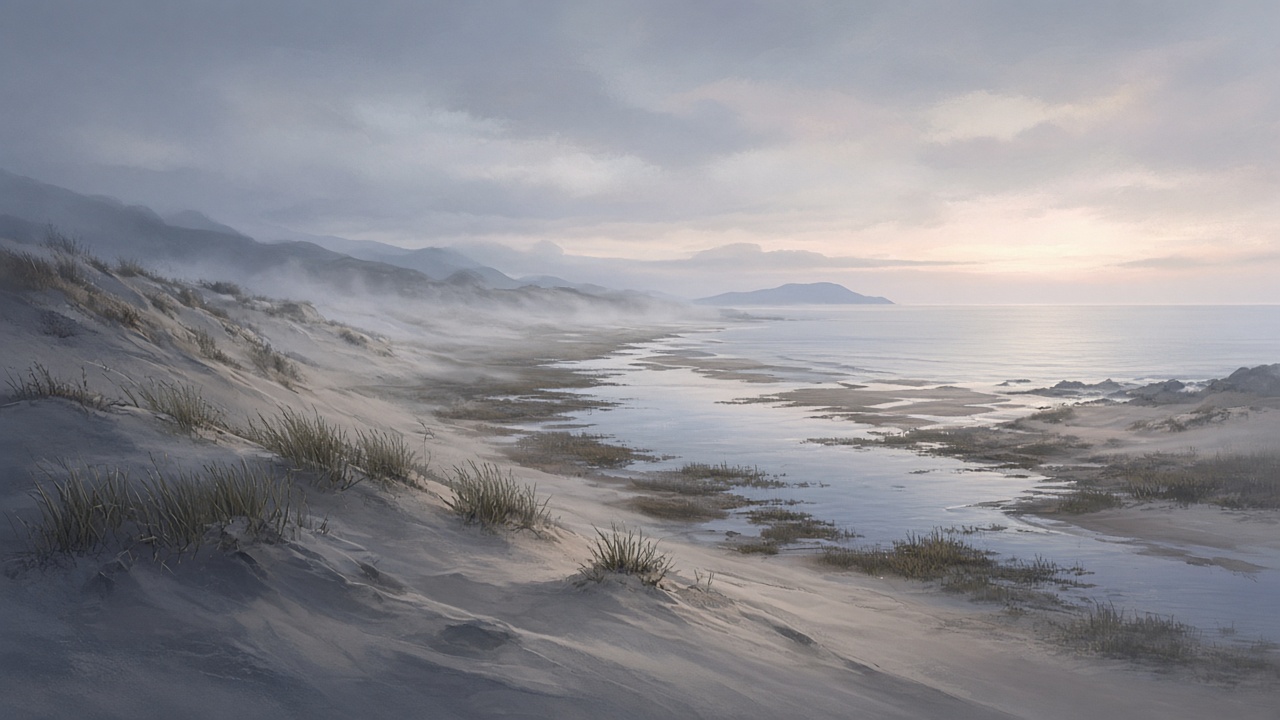
- The coast is arranged in bands parallel to the shore, from the intertidal zone to the grey dune.
- Sandy shores make up about 31% of the world’s ice-free coastline according to the IUCN.
- Saltmarshes are flooded by spring tides and carry salt-tolerant plants.
- Grey and harbour seals haul out on sandbanks and rocks exposed at low tide.
Definition and boundaries
This sheet brings together soft shores and the land behind them: beaches and dunes (group MT1.3 of the IUCN typology), mudflats and saltmarshes (group MFT1.3). Rocky cliffs, lagoons and the open sea are not covered; freshwater marshes behind the dunes belong to the Wetlands sheet.
Distribution
Sandy shores occur at every latitude; the IUCN estimates that they form about 31% of the ice-free coastline. Saltmarshes dominate sheltered coasts in temperate and boreal regions, while mangroves replace them in the tropics. In Europe, the Wadden Sea, the Bay of Somme and the Bay of Mont-Saint-Michel are examples.
Climate
The sea moderates the climate: milder winters and cooler summers than inland. Wind is almost constant; it moves sand, deposits salt spray and dries out plants. Storms and spring tides can reshape the shoreline within a few hours.
Soils, relief and water
The substrate ranges from coarse sand on exposed beaches to fine mud in sheltered bays. Dune sand is poor in nutrients and water; saltmarsh mud is rich but saturated with salt water and low in oxygen. The tide floods and uncovers the intertidal zone twice a day.
Structuring vegetation
On the dune, marram grass fixes the moving sand, then grassland and scrub colonise the stabilised grey dune. Saltmarshes are zoned by flooding frequency: glassworts and cordgrass at the bottom, sea purslane and saltmarsh grass higher up. Eelgrass beds occupy the low mudflats.
Characteristic fauna
Grey and harbour seals rest on sandbanks and rocks and give birth on quiet beaches. Mudflats feed waders and ducks; dunes shelter European rabbits and red foxes. The Eurasian otter uses estuaries and coasts where it can find fresh water to rinse its fur. On Arctic coasts, the Arctic fox scavenges along the strandline and around seabird colonies.
Functioning and dynamics
The coast is mobile: dunes advance or retreat with the sand supply, and saltmarshes build up by trapping sediment. Mudflats store a lot of carbon. Tides set a daily rhythm: wildlife feeds at low tide and gathers on roosts at high tide.
Threats
Urban development, sea walls and rock armour stop the coast from moving as sea level rises. Trampling destroys dune vegetation. Land reclamation has removed many saltmarshes. Disturbance of high-tide roosts tires migrating birds and seals.
Field reading
Check the tide tables before going out: the sea rises fast over flat tidal areas and can cut off your way back. Channels, creeks and soft mud are dangerous. Watch roosts from a distance without approaching resting seals. Stay on marked paths across the dunes.
This sheet describes a habitat. It publishes no season, quota or hunting authorisation: those rules must be checked with the competent authorities of the territory concerned.
Documented gaps
- Cliffs, rocky shores and mangroves are not described.
- Waders are not linked to species sheets (the catalogue only contains mammals).
- No figures on shoreline retreat by region.
Sources
- IUCN Global Ecosystem Typology — MT1.3 Sandy shores (consulted 2026-11-04)
- IUCN Global Ecosystem Typology — MFT1.3 Coastal saltmarshes and reedbeds (consulted 2026-11-04)
Related species
Related techniques
Practice information — not a legal authorisation.
Frequently asked questions
What is a saltmarsh?
A low meadow on the upper shore, flooded by spring tides, where only salt-tolerant plants such as glassworts can grow.
Why are dunes fragile?
Their vegetation holds the sand. When it is trampled or pulled up, the wind cuts gaps and the dune moves or collapses.
Can I approach seals?
Keep your distance: a disturbed seal flees into the water, wastes energy and may abandon its pup.
Does this sheet authorise hunting in this habitat?
This sheet describes a habitat. It publishes no season, quota or hunting authorisation: those rules must be checked with the competent authorities of the territory concerned.
Gallery
Keep exploring
Connect this environment to documented species, techniques and other habitats — without confusing ecological description with hunting authorisation.