- Family
- Bowhunting
- Difficulty
- High: it takes regular practice, short ranges and real skill at stalking or keeping still in a hide
- Organisation
- Alone or with a guide, often a professional hunter in South Africa
- Key gear
- A tuned hunting bow, arrows with broadheads, a covered quiver, binoculars
- Season
- Varies by species, country and province: check with the competent authority
- Who it suits
- Trained archers, used to 3D target courses, who accept passing up many chances
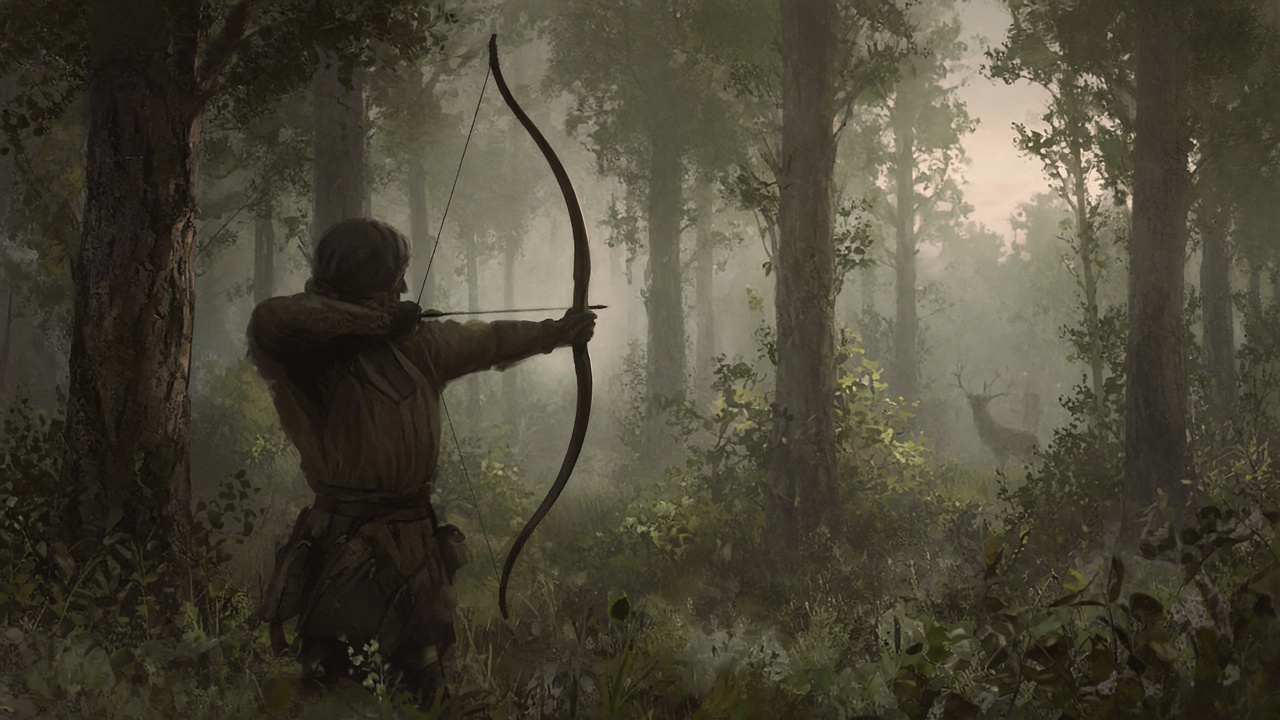
What is the idea behind bowhunting?
An arrow does not kill by shock the way a bullet does: the broadhead cuts blood vessels and the animal dies from blood loss. The arrow must therefore reach the heart and lungs of a calm animal standing broadside or quartering away, and the archer passes on any angle where the shoulder or bone shields those organs.
Everything happens at close range. The archer has to bring the animal very near without being seen and, above all, draw the bow without being noticed: the draw is the most delicate moment. That is why most outings are spent in a hide, whether a ground blind, a high seat or a blind by a waterhole, or stalking where the ground allows.
After the release, the archer watches the animal’s reaction and the direction it runs, then, if possible, the arrow: blood, hair and the colour of the sign tell you where it was hit. You do not set off on the trail straight away. How long to wait depends on the hit and is decided with the guide or the blood-tracking dog handler, rather than pushing a wounded animal.
How does bowhunting work in the field?
What equipment do you need for bowhunting?
- A hunting bow suited to the archer and the quarry, meeting any draw-weight or energy requirements set by the country
- Fixed-blade or mechanical broadheads, as local rules allow, always razor sharp
- A rangefinder where permitted, to know the exact distance before you release
- A quiver that covers broadhead blades
Safety rules for bowhunting
- Keep arrows in a closed quiver when moving and nock only when you are about to shoot
- Never draw or release towards ground you cannot see beyond the animal: an arrow that passes through or misses can carry a long way
- Approach a hit boar or warthog with care, even if it seems to be down
- Handle hunting arrows like blades: never in hand when crossing rough ground
Common mistakes in bowhunting
- Switching to broadheads just before the season without re-checking your setup: they do not always fly like practice points
- Drawing too early and holding at full draw while waiting for the animal to turn
- Following a hit animal immediately and pushing it beyond reach of a search
- Shooting beyond the distance you have practised
Which species are hunted by bowhunting?
Where is bowhunting practised?
British Columbia (Canada)
Bows are legal, including for moose, caribou, elk, grizzly bear, mountain sheep and mountain goat, subject to a minimum draw weight and broadhead width for big game. Bows may not be used from a vehicle.
Quebec (Canada)
In Quebec, bowhunting is allowed with a hunter's certificate bearing code A or B, obtained after training specific to bows and crossbows; non-residents are exempt. Minimum draw weight and broadhead cutting-diameter requirements vary by species.
Croatia
Zakon o lovstvu (NN 99/2018), čl. 66 st. 1 toč. 21 : luk i strijela parmi les modes de chasse réglementés.
Finland
In Finland, the bow is allowed for a list of species set by the Hunting Decree, including roe deer, several other deer species, mouflon and wild boar, but not moose or bear. For these ungulates, archers must pass an official bow shooting test and use a cutting broadhead.
France
In France, bowhunting is governed by the order of 18 August 2008, amended in 2012: archers must have attended a dedicated training session run by a departmental hunting federation and show their certificate when checked. The order also sets which bows and broadheads are allowed and requires every arrow to be marked.
Hungary
In Hungary, the Hunting Act lists the hunting bow among the lawful means of taking game. Archers need a valid hunting licence and must have passed a supplementary bowhunting exam; a minimum draw force applies to big game.
South Africa
GN 456 (NEMBA) : chasse à l’arc encadrée par normes nationales et permis provinciaux (p. ex. Western Cape — Implementation Guideline bow-hunting).
Spain
In Spain, bowhunting is a matter for the autonomous communities. In Andalusia, the 2017 hunting regulation allows it in every authorised hunting method and sets equipment requirements; in the Region of Murcia, the annual hunting-season order also requires a qualified-archer accreditation obtained after federation training.
Alaska (United States)
Bows are allowed for big game subject to minimum draw weights that vary by species (higher for moose, brown bear, mountain goat, muskox and bison), with arrow length and weight requirements and a non-barbed broadhead. Bowhunter certification (IBEP) is required for archery-only hunts.
Where this practice is not permitted
England: Wildlife and Countryside Act 1981, s. 5 : killing or taking wild birds with a bow or crossbow is prohibited (England and Wales). legislation.gov.uk
Norway: Regulations on the exercise of hunting (Norway), ch. 5, s. 15 : permitted hunting weapons — bow is not listed as a big-game hunting method. Lovdata
Scotland: Wildlife and Countryside Act 1981, s. 5 : bow or crossbow for wild birds is prohibited; bow hunting of deer is not a documented mainstream practice. legislation.gov.uk
Sweden: Bow hunting is not authorised in Sweden under national rules on weapons and hunting methods. Naturvårdsverket
Rules vary by country and region: check with the local authority. See the sources
Bowhunting compared with neighbouring techniques
Bowhunting uses the same two broad methods as rifle hunting, stand hunting and stalking, but at much shorter ranges and with less margin for error. Where it is permitted, baited stand hunting is often paired with the bow because it brings the animal close to the hide. Compared with a rifle stalk, the archer must also manage to draw without being seen.
Key terms in bowhunting
- hunting bow
- A longbow, recurve or compound bow with enough draw weight for the quarry under local rules.
- broadhead
- A bladed arrow point that kills by haemorrhage, unlike target points.
- nock
- The slotted end of an arrow that clips onto the string; to nock is to fit the arrow to the string before shooting.
- stand hunting
- Waiting motionless at a chosen spot on a game trail or near an area that game uses.
- shot signs
- Hair, blood, fragments or the animal’s reaction that tell you where it was hit.
- shot site
- Where the animal stood when it was shot; the starting point of the search.
- blood-tracking dog
- A dog trained to find wounded big game, worked on a long lead by a handler.
Frequently asked questions about bowhunting
What is bowhunting?
It is big-game hunting with a bow and arrows fitted with sharp broadheads, at short range, usually from a hide and sometimes by stalking.
Is bowhunting practised in France?
Yes, after specific training run by the departmental hunting federations. The exact conditions should be checked with the federation of the département before going out.
Which kind of bow can you hunt with?
Longbow, recurve or compound: the choice is up to the archer. Some countries set a minimum draw weight or arrow energy by quarry; check these requirements locally, along with the types of broadhead accepted.
How long should you wait after a bow shot?
There is no single answer: it depends on where the animal was hit, which you read from the arrow, the blood and its reaction. The guide or blood-tracking dog handler helps decide when to follow up.
Can you hunt with a crossbow?
A crossbow is not a bow and falls under different rules from country to country. Its status has to be checked separately with the competent authority.
What game is hunted with a bow in South Africa?
Mainly antelope such as greater kudu, and warthog, often from a hide by a waterhole. The species allowed and the equipment required vary by province and by property.
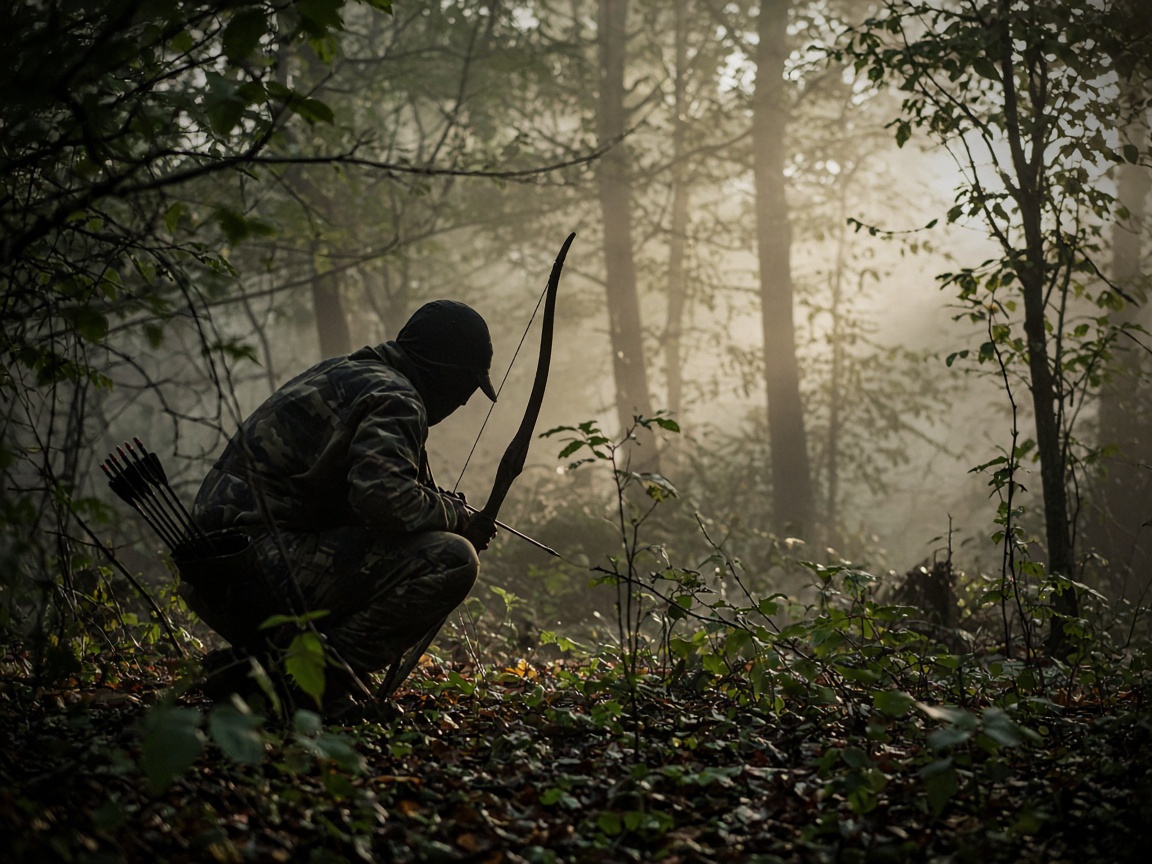
Bowhunting in pictures
Sources and references on bowhunting
- Real Federación Española de Caza (RFEC) — Modalidades, licencias y federaciones autonómicas (consulted on )
- Boletín Oficial del Estado (BOE) — Legislación estatal y autonómica de caza (consulted on )
- Bowhunting.co.za — Bowhunting in South Africa (consulted on )
- Department of Forestry, Fisheries and the Environment (DFFE) — Biodiversity, hunting and permits in South Africa (consulted on )
- Professional Hunters’ Association of South Africa (PHASA) — Professional hunting in South Africa (consulted on )
- AIDA (INERIS) — Arrêté du 18 août 2008 relatif à l'exercice de la chasse à l'arc, modifié par l'arrêté du 16 juillet 2012 (art. 2 à 12) (consulted on )
- Fédération nationale des chasseurs (FNC) — Chasseur de France : pratiques, sécurité et fédérations départementales (consulted on )
- Union nationale pour l’utilisation du chien de rouge (UNUCR) — Recherche au sang du grand gibier blessé (consulted on )
- Junta de Andalucía (BOJA n.º 149, 2017) — Decreto 126/2017, de 25 de julio, Reglamento de Ordenación de la Caza en Andalucía, art. 82.4 (caza con arco o ballesta) y art. 83.3 (consulted on )
- Suomen riistakeskus (Finnish Wildlife Agency) — Ampumakokeet : jousiampumakoe ja jousimetsästyksestä yleisesti (metsästysasetus 20 §) (consulted on )
- Narodne novine — Zakon o lovstvu (NN 99/2018), članak 66. stavak 1. točke 12 i 21 (samostrijel ; luk i strijela) (consulted on )
- Nemzeti Jogszabálytár — 1996. évi LV. törvény a vad védelméről, a vadgazdálkodásról, valamint a vadászatról, 59. § (1) d) et 67. § (1) c), (2) (consulted on )
- Likumi.lv (Latvijas Vēstnesis) — Medību likums, 24. pants, 9. punkts i) apakšpunkts (arbaleti, loki) (consulted on )
- Lovdata — Forskrift om utøvelse av jakt, felling og fangst, kapittel 5, § 15 Våpen under jakt og felling (consulted on )
- Dziennik Ustaw (Rządowe Centrum Legislacji) — Rozporządzenie Ministra Środowiska z dnia 23 marca 2005 r. w sprawie szczegółowych warunków wykonywania polowania i znakowania tusz (Dz.U. 2005 nr 61 poz. 548), zm. 2010, 2011, 2019 i 2025 : § 2, § 3, § 5, § 17, § 25, § 40 (consulted on )
- Portal Legislativ (Ministerul Justiției) — Legea vânătorii și a protecției fondului cinegetic nr. 407/2006, forme actualisée : art. 24, 39, 42 et annexe 1 (consulted on )
- Naturvårdsverket — Frågor och svar om föreskrift NFS 2023:8 om vapen och ammunition för jakt (pilbågsjakt) (consulted on )
- BC Laws (King's Printer) — Hunting Regulation, B.C. Reg. 190/84 (last amended October 1, 2026), ss. 17 and 18 (consulted on )
- Gouvernement du Québec — Armes de chasse, munitions et équipements : arbalète et arc (consulted on )
- Alaska Department of Fish and Game — 2026–2027 Alaska Hunting Regulations : general information, bow and arrow, big game restrictions, guide requirements (consulted on )
- legislation.gov.uk — Deer Act 1991, section 4(2)(b) : use of any arrow, spear or similar missile (England and Wales) (consulted on )
- legislation.gov.uk — Deer (Scotland) Act 1996, section 17(3) : killing or injuring deer otherwise than by shooting ; 'shoot' defined in section 45 (consulted on )
- Government of South Africa (gov.za) — NEMBA : Norms and standards for hunting methods in South Africa (GN 456, Government Gazette 34326), paragraphs 6 and 7 (bow hunting) (consulted on )
- legislation.gov.uk — Wildlife and Countryside Act 1981, section 5(1)(c)(i) : bow or crossbow for killing or taking wild birds (versions England and Wales, and Scotland) (consulted on )
Practice information — not a legal authorisation.