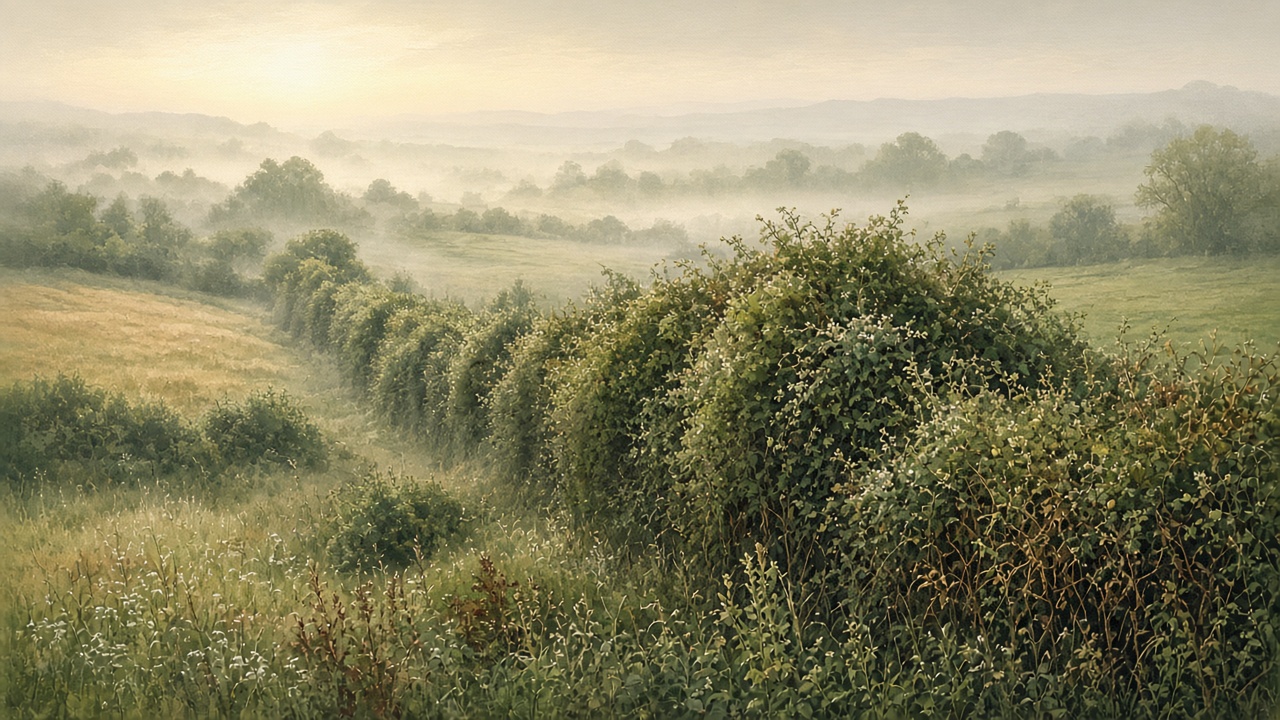
- Bocage is a human-made farming landscape, found mainly in western Atlantic Europe.
- France has about 1.55 million kilometres of hedges according to the IGN, as cited by the French Ministry of Agriculture.
- In France, 70% of hedgerow length has disappeared since 1950; the loss is estimated at 23,500 km a year over 2017–2021.
- A tall, wide and continuous hedge is worth far more than a low, isolated, trimmed one.
Definition and boundaries
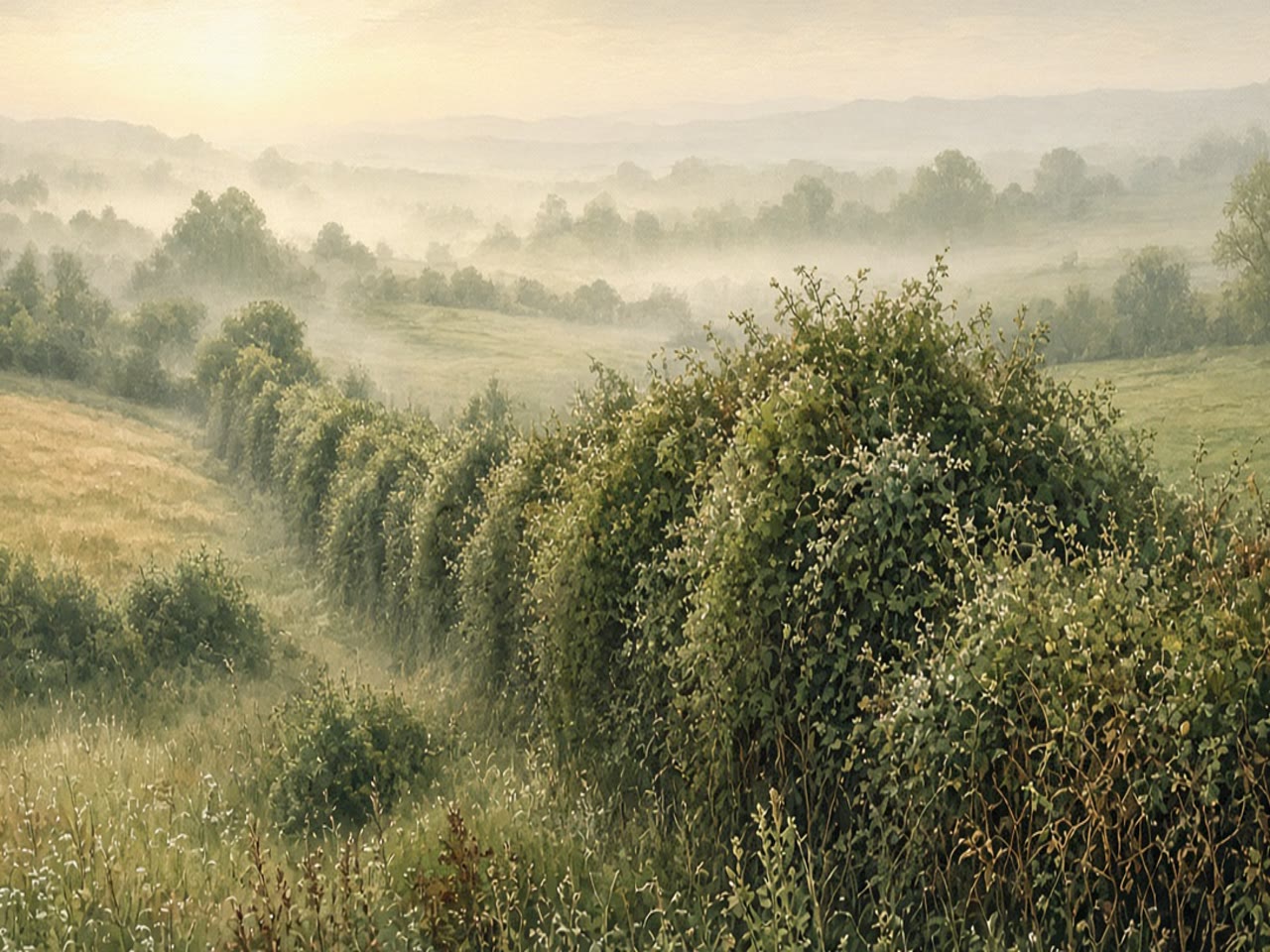
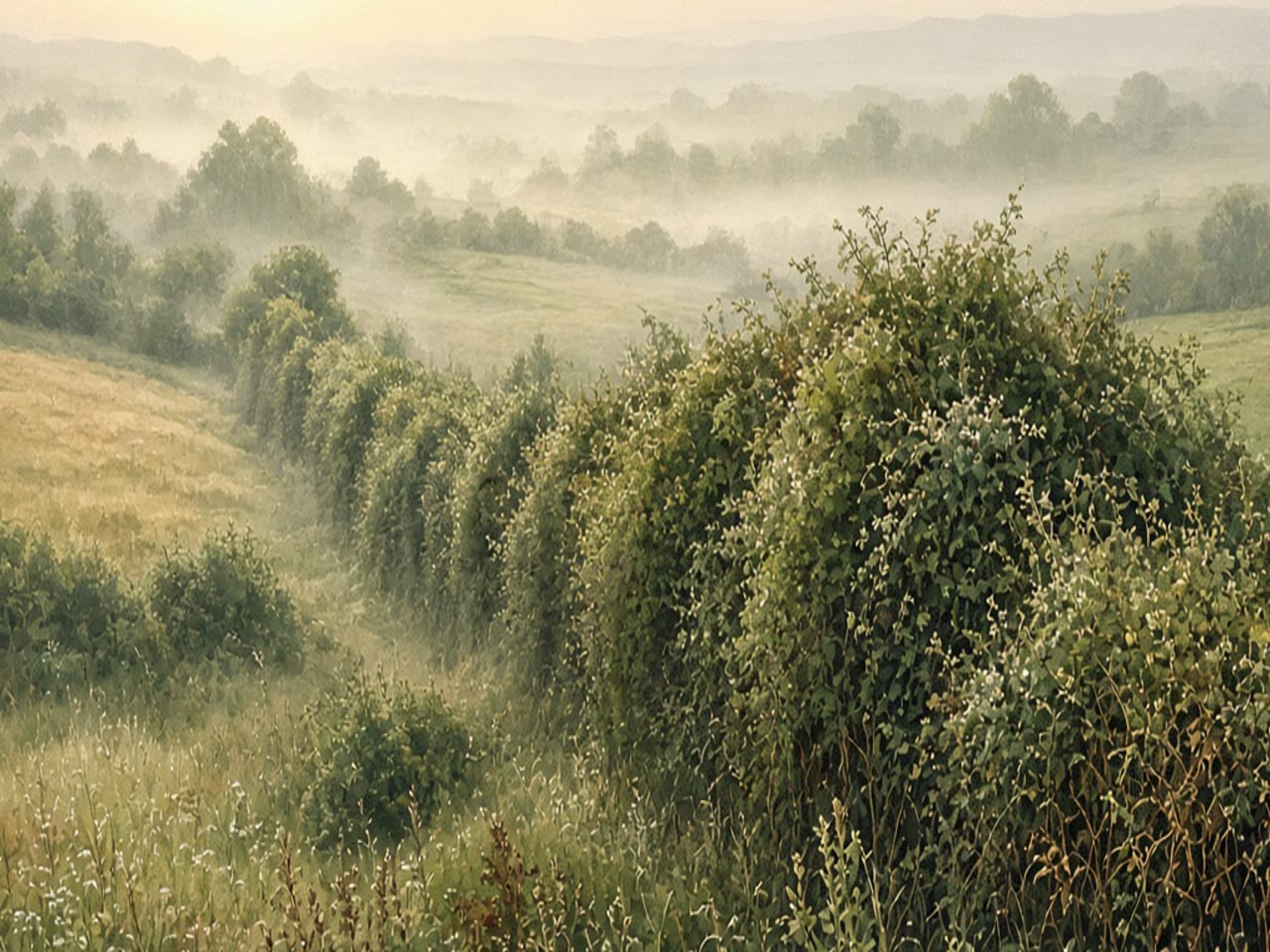
Bocage refers to a landscape of fields enclosed by living hedges, often planted on banks and lined with ditches. It does not match a single group of the IUCN typology: it combines grassland, crops and linear woody features. Open plains without hedges belong to the Farmland sheet.
Distribution
Bocage is typical of Atlantic Europe: Brittany, Normandy, the Loire region and the Massif Central in France, as well as Great Britain, Ireland, Galicia and Asturias. Comparable landscapes exist elsewhere, but the term comes from western France and refers first to this regional pattern.
Climate
The oceanic climate, mild and moist all year, favours grass and therefore livestock farming, which created many hedges. Hedges slow the wind, reduce evaporation, shelter livestock and create beneath them a microclimate that is cooler in summer and less cold in winter.
Soils, relief and water
Hedges on banks hold soil on slopes and slow surface runoff; ditches channel the water. Their roots improve infiltration and limit soil erosion. The network often follows the relief and old property boundaries, which explains its irregular pattern.
Structuring vegetation
A complete hedge has a herb layer, shrubs (hawthorn, blackthorn, hazel, elder) and trees (oak, ash, sweet chestnut), often managed as pollards. Old hollow trees, ivy and brambles provide cavities, fruit and cover. A mix of species spreads flowering and fruiting through the year.
Characteristic fauna
Hedgehog, badger, stone marten, weasel and stoat live along hedges; roe deer and red fox shelter there by day. Old trees host bats and owls. Hedge birds (shrikes, buntings, warblers) nest there, and many pollinating insects feed there.
Functioning and dynamics
Bocage depends on management: trimming, coppicing and pollarding renew hedges. Left alone, they spread into scrub; cut too hard, they lose value. Their worth for wildlife lies in connection: an isolated hedge does little, while a dense network lets animals cross the landscape under cover.
Threats
According to the French Ministry of Agriculture, 70% of hedgerow length in France has disappeared since 1950, and the loss is estimated at 23,500 km a year over 2017–2021, out of a remaining length of about 1.55 million km (IGN). The ministry attributes this decline to land consolidation and the decline of livestock farming; overly severe trimming and lack of renewal also weaken the remaining hedges. The Hedgerow Pact, presented in September 2023, aims for a net gain of 50,000 km by 2030.
Field reading
Animals move along hedges and cross them through regular gaps, visible as openings at the foot of banks. Field corners, hedge junctions and open gates concentrate movements. Wind swirls around hedges: take this into account before settling at an edge.
This sheet describes a habitat. It publishes no season, quota or hunting authorisation: those rules must be checked with the competent authorities of the territory concerned.
Documented gaps
- Hedge-loss figures cover France only.
- Hedge birds and bats are not linked to species sheets.
- Public grants for planting are not described.
Sources
- Ministère de l’Agriculture — Pacte en faveur de la haie (consulted 2026-11-04)
- Ministère de l’Agriculture — La haie, levier de la planification écologique (consulted 2026-11-04)
Related species
Related techniques
Practice information — not a legal authorisation.
Frequently asked questions
What is a pollard?
A tree whose branches are cut back regularly at about head height. It forms a swollen crown that hollows with age and provides cavities for wildlife.
Why does hedge connectivity matter?
Many animals avoid large open spaces. A continuous network lets them move, feed and disperse under cover.
Does bocage exist outside France?
Yes, notably in Great Britain, Ireland and north-west Spain, with comparable hedges, banks and stone walls.
Does this sheet authorise hunting in this habitat?
This sheet describes a habitat. It publishes no season, quota or hunting authorisation: those rules must be checked with the competent authorities of the territory concerned.
Gallery
Keep exploring
Connect this environment to documented species, techniques and other habitats — without confusing ecological description with hunting authorisation.